
Technical Support & Resources
Visit our FAQ
Contact Us
Toll Free Phone (USA and Canada Only): (888) 526-5351
Direct Phone: (734) 975-3888
Product Categories
Product Type
Application
CD44 Extracellular Domain (human, recombinant)
Item No. 32016
Technical Information
- CDw44
- Extracellular Matrix Receptor III
- Heparin Sulfate Proteoglycan
- HUTCH-I
- Hyaluronate Receptor
- PGP-1
Shipping & Storage Information
Recommended Products
Certificates of Analysis & Batch Specific Data
Provide batch numbers separated by commas to download or request available product inserts, QC sheets, certificates of analysis, data packs, and GC-MS data.

Visit Our Cancer Resource Center
Find Tools & Resources to Study the Hallmarks of Cancer
- Cancer cell signaling & regulation
- Cancer metabolism
- Tumor microenvironment
Product Description
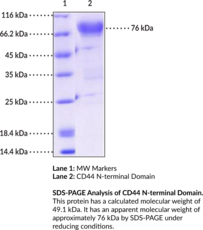
CD44 is a type I transmembrane glycoprotein and cell adhesion molecule belonging to the cartilage link protein family with roles in cell-cell and cell-matrix interactions, signal transduction, and cell migration.1,2,3 It is comprised of an N-terminal extracellular globular domain with a link domain that binds to the extracellular matrix component hyaluronan (HA) and other glycosaminoglycans, a membrane-proximal stem structure, a transmembrane domain, and a cytoplasmic domain that facilitates interactions with cytoskeleton-associated proteins.1,4 The stem structure of CD44 can be modified via inclusion of variant exons between amino acid residues 222 and 223, resulting in several variant (CD44v) isoforms with the shortest and most prevalent isoform, known as the standard isoform (CD44s) or hematopoietic isoform (CD44H), having no exon insertions at this position.1,5,6 CD44 is expressed in a variety of cell types, including endothelial and epithelial cells, fibroblasts, and leukocytes.2 Binding of CD44 to HA is induced in T cells and monocytes upon antigen recognition and activation by inflammatory stimuli, respectively.7 The interaction between CD44 and HA mediates T cell rolling and recruitment of leukocytes to sites of inflammation. Several CD44 isoforms are expressed in tumor cells, including CD44v6, the overexpression of which is associated with tumor differentiation and lymph node metastasis in patients with non-small cell lung cancer (NSCLC).8,9 Cayman's CD44 N-terminal Domain (human, recombinant) protein is a disulfide-linked homodimer. The reduced monomer, comprised of CD44 (amino acids 21-220) fused to human IgG1 Fc at its C-terminus, consists of 441 amino acids, has a calculated molecular weight of 49.1 kDa, and a predicted N-terminus of Gln21 after signal peptide cleavage. The monomer migrates at approximately 76 kDa by SDS-PAGE under reducing conditions.
WARNING This product is not for human or veterinary use.
References & Product Citations
1. CD44: From adhesion molecules to signalling regulators. Nat. Rev. Mol. Cell Biol. 4(1), 33-45 (2003).
2. A role for the cell adhesion molecule CD44 and sulfation in leukocyte-
3. Molecular organization, structural features, and ligand binding characteristics of CD44, a highly variable cell surface glycoprotein with multiple functions. Proteins 39(2), 103-111 (2000).
4. CD44: Can a cancer-
5. CD44 structure and function. Front. Biosci. 3, d616-d630 (1998).
6. The role of the CD44/ezrin complex in cancer metastasis. Crit. Rev. Oncol. Hematol. 46(2), 165-186 (2003).
7. CD44 and its role in inflammation and inflammatory disease. Inflamm. Allergy Drug Targets 8(3), 208-220 (2009).
8. Concise review: Emerging role of CD44 in cancer stem cells: A promising biomarker and therapeutic target. Stem Cells Transl. Med. 4(9), 1033-1043 (2015).
9. Prognostic value of CD44 expression in non-
Contact Info
Cayman Chemical1180 East Ellsworth RoadAnn Arbor, Michigan 48108 USAToll Free: (800) 364-9897(USA and Canada only)Fax: (734) 971-3640


