
Technical Support & Resources
Visit our FAQ
Contact Us
Toll Free Phone (USA and Canada Only): (888) 526-5351
Direct Phone: (734) 975-3888
Product Categories
Product Type
Research Area
Application
Technical Information
- Signal Transducer and Activator of Transcription-1β
- STAT84
- Transcription Factor ISGF-3 Component p84
Shipping & Storage Information
Recommended Products
Certificates of Analysis & Batch Specific Data
Provide batch numbers separated by commas to download or request available product inserts, QC sheets, certificates of analysis, data packs, and GC-MS data.

Visit Our Cancer Resource Center
Find Tools & Resources to Study the Hallmarks of Cancer
- Cancer cell signaling & regulation
- Cancer metabolism
- Tumor microenvironment
Product Description
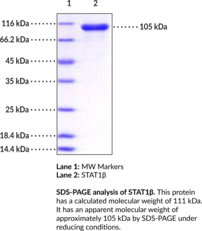
STAT1, also known as STAT1α, is a transcription factor and member of the STAT protein family with roles in innate and adaptive immunity.1 It is composed of an N-terminal domain that is essential to protein-protein interactions and dimerization, a DNA binding domain that facilitates nuclear import and export, as well as DNA binding, a linker domain, tail segment, and a transactivation domain that facilitates transcription of target genes.2 STAT1β is an isoform of STAT1 that is formed by alternative splicing and lacks the 38-amino acid transactivation domain.3 Upon phosphorylation by JAKs, STAT1 dimerizes and is translocated to the nucleus to activate transcription of IFN-γ-inducible genes.4 Because the C-terminal transactivation domain is required for STAT1 interaction with the transcriptional coactivator CREB-binding protein (CBP)/p300 and gene transcription, STAT1β is considered a dominant-negative regulator of STAT1 and overexpression of STAT1β inhibits IFN-γ-induced gene expression in RAW 264.7 cells. STAT1β phosphorylation is increased and IFN-γ-induced JAK1, JAK2, and STAT1 activation is decreased in RAW 264.6 cells infected with L. major and L. mexicana parasites, as well as M. avium bacteria.4,5 STAT1β protein levels are reduced in patient-derived esophageal squamous cell carcinoma (ESCC) tumor samples and are positively correlated with lymph node metastasis, invasion, and shorter overall survival.3 Cayman’s STAT1β (human, recombinant) protein consists of 950 amino acids and has a calculated molecular weight of 111 kDa.
WARNING This product is not for human or veterinary use.
References & Product Citations
1. The good and the bad faces of STAT1 in solid tumours. Cytokine 89, 12-20 (2017).
2. Inborn errors of human STAT1: Allelic heterogeneity governs the diversity of immunological and infectious phenotypes. Curr. Opin. Immunol. 24(4), 364-378 (2012).
3. STAT1β enhances STAT1 function by protecting STAT1α from degradation in esophageal squamous cell carcinoma. Cell Death Dis. 8(10), e3077 (2017).
4. Mycobacterium avium inhibition of IFN-
5. Leishmania inhibits STAT1-
Contact Info
Cayman Chemical1180 East Ellsworth RoadAnn Arbor, Michigan 48108 USAToll Free: (800) 364-9897(USA and Canada only)Fax: (734) 971-3640


