
Technical Support & Resources
Visit our FAQ
Contact Us
Toll Free Phone (USA and Canada Only): (888) 526-5351
Direct Phone: (734) 975-3888
Product Categories
Product Type
Application
Technical Information
- CD120b
- TNFR2
- DS-TNFR2(Δ7,8)
- TNFRSF1B
- Tumor Necrosis Factor Receptor 2
- Tumor Necrosis Factor Receptor Superfamily Member 1B
Shipping & Storage Information
Recommended Products
Certificates of Analysis & Batch Specific Data
Provide batch numbers separated by commas to download or request available product inserts, QC sheets, certificates of analysis, data packs, and GC-MS data.
Product Description
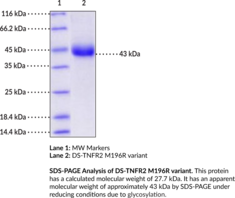
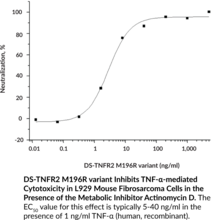
TNF receptor 2 (TNFR2), also known as CD120b or TNFRSF1B, is a TNF-α receptor encoded by TNFRSF1B and expressed in cells of hematopoietic origin, as well as endothelial cells.1,2,3 Alternative splicing leads to the formation of a soluble, secreted isoform of TNFR2, known as differential splicing TNFR2 (DS-TNFR2), lacking the transmembrane and cytoplasmic domains.1 Cell supernatants containing DS-TNFR2 inhibit TNF-α-induced cytotoxicity in L929 cells. Serum levels of DS-TNFR2 are elevated in patients with rheumatoid arthritis. Single nucleotide polymorphisms in TNFRSF1B resulting in a methionine-to-arginine substitution at position 196 (M196R) are associated with susceptibility to systemic lupus erythematosus (SLE) in Japanese patients, rheumatoid arthritis risk in European patients, and polycystic ovary syndrome (PCOS) in female patients.4,3,2 Cayman's DS-TNFR2 M196R variant (human, recombinant) protein can be used for cell-based assay applications. This protein consists of 257 amino acids, has a calculated molecular weight of 27.7 kDa, and a predicted N-terminus of Leu23 after signal peptide cleavage. By SDS-PAGE, under reducing conditions, the apparent molecular mass of the protein is approximately 43 kDa due to glycosylation.
WARNING This product is not for human or veterinary use.
References & Product Citations
1. Identification and characterization of a novel spliced variant that encodes human soluble tumor necrosis factor receptor 2. Int. Immunol. 16(1), 169-177 (2004).
2. Comment: The methionine 196 arginine polymorphism in exon 6 of the TNF receptor 2 gene (TNFRSF1B) is associated with the polycystic ovary syndrome and hyperandrogenism. J. Clin. Endocrinol. Metab. 87(8), 3977-3983 (2002).
3. Associations between functional TNFR2 196 M/R polymorphisms and susceptibility to rheumatoid arthritis: A meta-
4. Association of tumor necrosis factor receptor 2 (TNFR2) polymorphism with susceptibility to systemic lupus erythematosus. Tissue Antigens 53(6), 527-533 (1999).
Contact Info
Cayman Chemical1180 East Ellsworth RoadAnn Arbor, Michigan 48108 USAToll Free: (800) 364-9897(USA and Canada only)Fax: (734) 971-3640


