
Technical Support & Resources
Visit our FAQ
Contact Us
Toll Free Phone (USA and Canada Only): (888) 526-5351
Direct Phone: (734) 975-3888
Product Categories
Product Type
Application
Ferritin Light Chain (human, recombinant)
Item No. 32032
Technical Information
- Epididymis Secretory Sperm Binding Protein
- Ferritin L-Chain
- Ferritin Light Polypeptide-like 3
- Ferritin L Subunit
- FTL
- L Apoferritin
- NBIA3
- Neurodegeneration with Brain Iron Accumulation 3
Shipping & Storage Information
Recommended Products
Certificates of Analysis & Batch Specific Data
Provide batch numbers separated by commas to download or request available product inserts, QC sheets, certificates of analysis, data packs, and GC-MS data.

Visit Our Cancer Resource Center
Find Tools & Resources to Study the Hallmarks of Cancer
- Cancer cell signaling & regulation
- Cancer metabolism
- Tumor microenvironment
Product Description
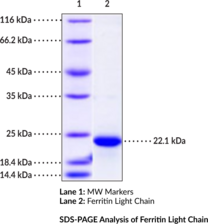
Ferritin is a spherical protein involved in iron storage and biomineralization.1,2 It is primarily localized to the cytoplasm, but is also present in the mitochondria and nucleus, and is composed of 24 protein subunits with a tissue-specific ratio of ferritin heavy chains (FTH1s; Item No. 32033) to ferritin light chains (FTLs). FTH1 and FTL are nearly identical in overall conformation but only share approximately 50% sequence homology.3 FTH1 functions as a ferroxidase that catalyzes the oxidation of Fe(II) to Fe(III), and FTL has roles in iron nucleation and protein stability. FTL is overexpressed in acute myeloid leukemia and leukemic stem cells compared with normal hematopoietic stem cells.4 Nucleotide duplications in FTL are associated with neuroferritinopathy, an autosomal dominant neurodegenerative disease characterized by the presence of intracellular ferritin inclusion bodies and iron accumulation in glia and neurons throughout the CNS.3 Point mutations in the 5’-UTR of FTL have been found in individuals with hereditary hyperferritinemia-cataract syndrome.5 Cayman’s Ferritin Light Chain (human, recombinant) protein consists of 191 amino acids and has a calculated molecular weight of 22.1 kDa.
WARNING This product is not for human or veterinary use.
References & Product Citations
1. Ferritin light-
2. Ferritin light chain confers protection against sepsis-
3. A mutant light-
4. Ferritin heavy/light chain (FTH1/FTL) expression, serum ferritin levels, and their functional as well as prognostic roles in acute myeloid leukemia. Eur. J. Haematol. 102(2), 131-142 (2019).
5. Ferritin light chain gene mutation in a large Australian family with hereditary hyperferritinemia-
Contact Info
Cayman Chemical1180 East Ellsworth RoadAnn Arbor, Michigan 48108 USAToll Free: (800) 364-9897(USA and Canada only)Fax: (734) 971-3640


