
Technical Support & Resources
Visit our FAQ
Contact Us
Toll Free Phone (USA and Canada Only): (888) 526-5351
Direct Phone: (734) 975-3888
Product Categories
Product Type
Application
Technical Information
- Cytosolic Inhibitor of Nrf2
- INRF2
- Kelch-Like ECH-Associated Protein 1
- KLHL19
Shipping & Storage Information
Recommended Products
Certificates of Analysis & Batch Specific Data
Provide batch numbers separated by commas to download or request available product inserts, QC sheets, certificates of analysis, data packs, and GC-MS data.

Visit Our Cancer Resource Center
Find Tools & Resources to Study the Hallmarks of Cancer
- Cancer cell signaling & regulation
- Cancer metabolism
- Tumor microenvironment
Product Description
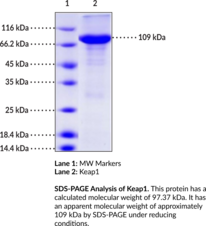
Kelch-like ECH-associated protein 1 (Keap1) is a substrate adapter protein in the Kelch-like (KLHL) family of proteins.1 It contains an N-terminal region, a BTB/POZ domain that facilitates protein binding and Keap1 dimerization, a central intervening region (IVR), a double glycine repeat (DGR)/Kelch repeat domain, a BACK that binds to other proteins, and a C-terminal region.1,2,3 KEAP1 is ubiquitously expressed and localized to the perinuclear region of the cytosol and bound to the actin skeleton via its DGR region.4,5,6 Under homeostatic conditions, it associates with Nrf2, preventing its nuclear translocation and promoting its ubiquitination and proteasomal degradation.2,6 In the presence of electrophiles or oxidants, Keap1 releases Nrf2, which translocates to the nucleus to induce the expression of cytoprotective genes.6 Somatic mutations in Keap1 have been found in various cancers and human cancer cell lines and are associated with loss of Keap1 function and constitutive activation of Nrf2, which contributes to tumor growth and chemoresistance.3 Cayman’s Keap1 (human, recombinant) protein is comprised of Keap1 (amino acids 2-264) fused to His and GST tags at its N-terminus, consists of 860 amino acids, and has a calculated molecular weight of 97.37 kDa. By SDS-PAGE, under reducing conditions, the apparent molecular mass of this protein is approximately 109 kDa.
WARNING This product is not for human or veterinary use.
References & Product Citations
1. .
2. .
3. .
4. .
5. .
6. .
Contact Info
Cayman Chemical1180 East Ellsworth RoadAnn Arbor, Michigan 48108 USAToll Free: (800) 364-9897(USA and Canada only)Fax: (734) 971-3640


