
Technical Support & Resources
Visit our FAQ
Contact Us
Toll Free Phone (USA and Canada Only): (888) 526-5351
Direct Phone: (734) 975-3888
Technical Information
- APO-1
- Apoptosis Antigen
- APT
- Cluster of Differentiation 95
- Fas
- TNFRSF6
- Tumor Necrosis Factor Receptor Superfamily, Member 6
Shipping & Storage Information
Recommended Products
Certificates of Analysis & Batch Specific Data
Provide batch numbers separated by commas to download or request available product inserts, QC sheets, certificates of analysis, data packs, and GC-MS data.

Visit Our Cancer Resource Center
Find Tools & Resources to Study the Hallmarks of Cancer
- Cancer cell signaling & regulation
- Cancer metabolism
- Tumor microenvironment
Product Description
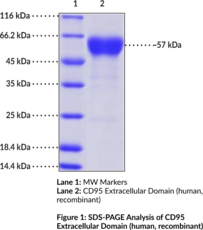
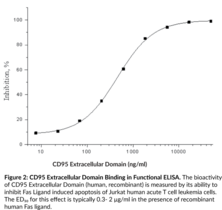
CD95 is a type I transmembrane glycoprotein receptor encoded by the FAS gene in humans.1 Alternative splicing of FAS generates a soluble form of the protein. CD95 is expressed by activated T and B cells and thymocytes, and has been found in the thymus, liver, heart, and kidney.2,3,4 CD95 is involved in the induction of apoptosis, as Fas ligand activation of CD95 leads to formation of a death-inducing signaling complex (DISC) comprised of CD95 oligomers, the Fas-associated death domain protein (FADD), procaspase-8, procaspase-10, and c-FLIP.5 DISC formation and CD95 internalization is rapid in type I apoptotic cells, where it is associated with plasma membrane lipid rafts, and delayed in type II apoptotic cells, where it is found in both lipid raft- and non-raft regions of the membrane.6,7 CD95 has non-apoptotic activity as well, including activation of the NF-κB signaling pathway and inducing renal tubular epithelial cell migration, among others.4 Inhibition or activation of CD95 reduces or promotes cancer cell functions, respectively, in vitro and in vivo in animal models. However, high serum levels of CD95 in patients with various cancers are associated with metastasis, progression, and shorter survival. Mice lacking the gene for CD95 develop spontaneous autoimmunity and have been used as a model of systemic lupus erythematosus (SLE). Mutations in FAS are associated with various cancers and autoimmune lymphoproliferative syndrome (ALPS) type 1a, which is characterized by non-malignant lymphadenopathy and splenomegaly.4,6 Cayman’s CD95 Extracellular Domain (human, recombinant) protein can be used for cell-based assay applications. This protein is a disulfide-linked homodimer. The reduced monomer, comprised of CD95 (amino acids 26-173) fused to IgG1 Fc at its C-terminus, consists of 386 amino acids, has a calculated molecular weight of 43.4 kDa, and a predicted N-terminus of Gln26 after signal peptide cleavage. As a result of glycosylation, the monomer migrates at approximately 55 to 60 kDa by SDS-PAGE under reducing conditions.
WARNING This product is not for human or veterinary use.
References & Product Citations
1. The CD95(APO-
2. Monoclonal antibody-
3. The role of CD95 and CD95 ligand in cancer. Cell Death Differ. 22(4), 549-559 (2015).
4. Regulation of CD95/Fas signaling at the DISC. Cell Death Differ. 19(1), 36-41 (2011).
5. CD95 death-
6. Autoimmune lymphoproliferative syndrome with defective Fas: Genotype influences penetranc. Am. J. Hum. Genet. 64(4), 1002-1014 (1999).
7. Two CD95 (APO-
Contact Info
Cayman Chemical1180 East Ellsworth RoadAnn Arbor, Michigan 48108 USAToll Free: (800) 364-9897(USA and Canada only)Fax: (734) 971-3640


