
Technical Support & Resources
Visit our FAQ
Contact Us
Toll Free Phone (USA and Canada Only): (888) 526-5351
Direct Phone: (734) 975-3888
Product Categories
Product Type
Application
Technical Information
- CSF2
- Granulocyte-macrophage Colony-stimulating Factor
Shipping & Storage Information
Recommended Products
Certificates of Analysis & Batch Specific Data
Provide batch numbers separated by commas to download or request available product inserts, QC sheets, certificates of analysis, data packs, and GC-MS data.
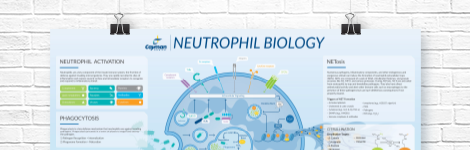
Neutrophil Biology Wall Poster
Explore how neutrophils shape the immune response in health and disease. This poster highlights neutrophil pathogen defense mechanisms, including phagocytosis, degranulation, and NETosis, as well as neutrophil roles in inflammation and NET-associated pathologies.
DOWNLOAD NOWProduct Description
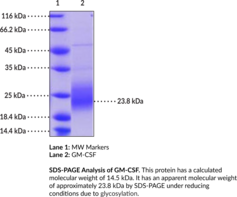
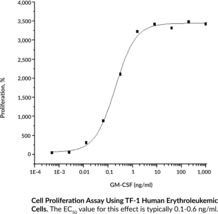
Granulocyte-macrophage colony-stimulating factor (GM-CSF) is a secreted glycoprotein encoded by the CSF2 gene in humans that promotes the differentiation, proliferation, and function of a variety of progenitor or mature cells.1,2 GM-CSF exists as a secreted, disulfide-linked monomer and is composed of four α-helices and two anti-parallel β-sheets that contain numerous glycosylation sites.2 GM-CSF production is induced in a variety of cells, including macrophages, T cells, neutrophils, and dendritic cells, by stimulation with pro-inflammatory cytokines, such as IL-1, TNF-α, or IL-12, and is decreased by cell stimulation with the anti-inflammatory cytokines IL-10 or IFN-γ.3 Binding of GM-CSF to the GM-CSF receptor, which is highly expressed on dendritic cells and their precursors, macrophages, and monocytes, promotes cell differentiation, proliferation, and survival and enhances several immunological functions, including chemotaxis, cytokine signaling, phagocytosis, antigen presentation, and pathogen killing.1,4 GM-CSF-deficient mice exhibit increased accumulation of pulmonary surfactant and protein and have been used as a model of pulmonary alveolar proteinosis.5 Neutralization of GM-CSF with a monoclonal antibody decreases joint cartilage destruction and TNF-α and IL-1β levels in a mouse model of collagen-induced arthritis.6 GM-CSF has been used to generate bone marrow-derived macrophages with a pro-inflammatory phenotype in vitro.3 Formulations containing GM-CSF have been used for myeloid cell reconstitution following chemotherapy. Cayman's GM-CSF (human, recombinant) protein can be used for cell-based assay applications. This protein consists of 127 amino acids, has a calculated molecular weight of 14.5 kDa, and a predicted N-terminus of Ala18 after signal peptide cleavage. By SDS-PAGE, under reducing conditions, the apparent molecular mass of the protein is approximately 23.8 kDa due to glycosylation.
WARNING This product is not for human or veterinary use.
References & Product Citations
1. GM-
2. Identification of an antigenic domain near the C terminus of human granulocyte-
3. Biological role of granulocyte macrophage colony-
4. GM-
5. Involvement of granulocyte-
6. Blockade of collagen-
Contact Info
Cayman Chemical1180 East Ellsworth RoadAnn Arbor, Michigan 48108 USAToll Free: (800) 364-9897(USA and Canada only)Fax: (734) 971-3640


