
Technical Support & Resources
Visit our FAQ
Contact Us
Toll Free Phone (USA and Canada Only): (888) 526-5351
Direct Phone: (734) 975-3888
Product Categories
Product Type
Application
Technical Information
- Dickkopf-related Protein 1
Shipping & Storage Information
Recommended Products
Certificates of Analysis & Batch Specific Data
Provide batch numbers separated by commas to download or request available product inserts, QC sheets, certificates of analysis, data packs, and GC-MS data.

Visit Our Cancer Resource Center
Find Tools & Resources to Study the Hallmarks of Cancer
- Cancer cell signaling & regulation
- Cancer metabolism
- Tumor microenvironment
Product Description
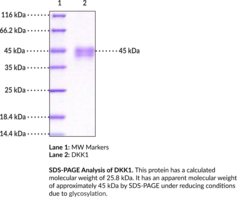
Dickkopf-related protein 1 (DKK1) is a glycoprotein and a member of the DKK family of proteins.1 DKK1 contains a signal sequence and N- and C-terminal conserved cysteine-rich domains connected by a non-conserved linker region. The C-terminal domain contains a colipase fold domain that is sufficient for its biological activity. DKK1 is a secretory protein that is expressed in osteoblasts, osteocytes, skin, placenta, prostate, and platelets.2 It binds to lipoprotein receptor-related protein 5/6 (LRP5/6) to prevent it from forming a β-catenin-stabilizing complex with Wnt and Frizzled, thus inactivating Wnt-β-catenin signaling. In the presence of the DKK1 co-receptor Kremen, LRP6 is endocytosed to prevent its interaction with Wnt and Frizzled. DKK1 is also a target of the β-catenin-TCF transcription factor complex forming a negative feedback loop for Wnt signaling.3 Dkk1 knockout in mice is embryonic lethal with embryos lacking anterior head structures, as well as having ectopic and fused digits and fused vertebrae.4 Mice heterozygous for Dkk1 have increased bone density, and overexpression of Dkk1 in mice leads to osteopenia.1 DKK1 expression is increased in a variety of cancers and plasma levels are correlated with the development of osteolytic lesion formation in patients with multiple myeloma.1,5 Activation of DKK1 in cancer cells in vitro and in vivo can inhibit growth, however, DKK1 inhibition can reduce tumor growth in certain mouse xenograft models, suggesting a cell- or tissue-specific effect.5,6 DKK1 expression is increased in the brain of Alzheimer’s disease mouse models, cerebrospinal fluid and plasma of patients with Alzheimer’s disease, and in postmortem brain derived from Alzheimer’s disease patients.7 Cayman’s DKK1 (human, recombinant) protein can be used for cell-based assay applications. This protein consists of 235 amino acids, has a calculated molecular weight of 25.8 kDa, and a predicted N-terminus of Thr32 or Ser35 after signal peptide cleavage. By SDS-PAGE, under reducing conditions, the apparent molecular mass of the protein is approximately 45 kDa due to glycosylation.
WARNING This product is not for human or veterinary use.
References & Product Citations
1. .
2. .
3. .
4. .
5. .
6. .
7. .
Contact Info
Cayman Chemical1180 East Ellsworth RoadAnn Arbor, Michigan 48108 USAToll Free: (800) 364-9897(USA and Canada only)Fax: (734) 971-3640


