
Technical Support & Resources
Visit our FAQ
Contact Us
Toll Free Phone (USA and Canada Only): (888) 526-5351
Direct Phone: (734) 975-3888
Product Categories
Product Type
Application
Technical Information
- CD40L
- CD154
- T-B Cell-activating Molecule
- T Cell Antigen Gp39
- TNF-related Activation Protein
- TNF Superfamily Member 5
Shipping & Storage Information
Recommended Products
Certificates of Analysis & Batch Specific Data
Provide batch numbers separated by commas to download or request available product inserts, QC sheets, certificates of analysis, data packs, and GC-MS data.
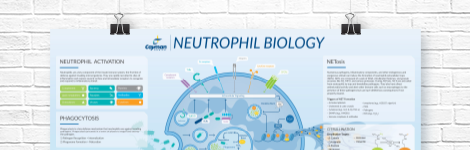
Neutrophil Biology Wall Poster
Explore how neutrophils shape the immune response in health and disease. This poster highlights neutrophil pathogen defense mechanisms, including phagocytosis, degranulation, and NETosis, as well as neutrophil roles in inflammation and NET-associated pathologies.
DOWNLOAD NOWProduct Description
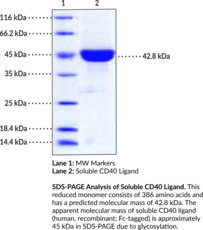
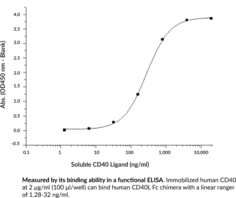
CD40 ligand (CD40L) is a type II transmembrane protein and member of the TNF superfamily encoded by CD40LG in humans.1 It is expressed primarily by activated T cells, as well as activated B cells and platelets and, under inflammatory conditions, can be induced in natural killer (NK) cells, mast cells, basophils, and monocytes. CD40L trimerizes to engage its receptor, CD40, on various cells, including B cells, dendritic cells, monocytes, platelets, macrophages, endothelial cells, and myoblasts, to induce cell type-specific signaling and activities. Soluble CD40L (sCD40L) is produced by proteolytic cleavage of CD40L at the cell surface and is found in the circulation.2,3 sCD40L retains its ability to trimerize and bind to CD40, indicating CD40L can act as a cytokine.2 Exogenous administration of sCD40L increases blood brain barrier (BBB) permeability and increases disease severity in a mouse model of experimental autoimmune encephalomyelitis (EAE).4 sCD40L enhances collagen-induced aggregation of isolated human platelets and exacerbates thrombus formation in wild-type, but not CD40-/-, mice.5 Serum levels of sCD40L are positively correlated with the albumin quotient, a marker of BBB breakdown, in patients with multiple sclerosis.4 Cayman’s Soluble CD40 Ligand (human, recombinant; Fc-tagged) protein can be used for ELISA. This protein is a disulfide-linked homodimer. The reduced monomer, comprised of CD40L (amino acids 113-261) fused to human IgG1 Fc at its N-terminus, consists of 386 amino acids and has a calculated molecular weight of 42.8 kDa.
WARNING This product is not for human or veterinary use.
References & Product Citations
1. Molecular mechanism and function of CD40/CD40L engagement in the immune system. Immunol. Rev. 229(1), 152-172 (2009).
2. CD40-
3. Soluble CD40 ligand directly alters glomerular permeability and may act as a circulating permeability factor in FSGS. PLoS One 12(11), e0188045 (2017).
4. Soluble CD40 ligand disrupts the blood-
5. Enhanced levels of soluble CD40 ligand exacerbate platelet aggregation and thrombus formation through a CD40-
Contact Info
Cayman Chemical1180 East Ellsworth RoadAnn Arbor, Michigan 48108 USAToll Free: (800) 364-9897(USA and Canada only)Fax: (734) 971-3640


