
Technical Support & Resources
Visit our FAQ
Contact Us
Toll Free Phone (USA and Canada Only): (888) 526-5351
Direct Phone: (734) 975-3888
Technical Information
- Bone Morphogenic Protein 2
Shipping & Storage Information
Recommended Products
Certificates of Analysis & Batch Specific Data
Provide batch numbers separated by commas to download or request available product inserts, QC sheets, certificates of analysis, data packs, and GC-MS data.
Product Description
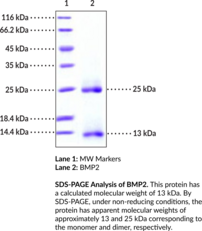
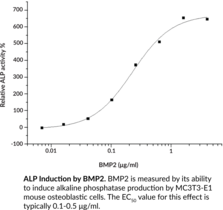
Bone morphogenetic protein 2 (BMP2) is a member of the TGF-β superfamily of growth factors that has roles in osteogenesis and embryogenesis.1 It is composed of an N-terminal prodomain that regulates BMP2 folding and secretion and a C-terminal mature domain that contains the receptor binding region. BMP2 is expressed by chondrocytes, osteocytes, osteoblasts, and vascular endothelial cells and is synthesized in the cytosol as a proprotein dimer.2,3 Cleavage of the proprotein dimer by proprotein convertase subtilisin kexins (PCSKs) generates the N- and C-terminal domains, which remain non-covalently associated and homodimerize or heterodimerize with BMP4 or BMP7 prior to secretion.2 BMP2 preferentially binds to BMP type 1 receptors, also known as activin receptor-like kinases (ALKs), which are expressed by mesenchymal or hematopoietic stem cells, chondrocytes, osteoblasts, osteoclasts, and myoblasts, and activates SMAD-dependent and -independent gene transcription.1,4 BMP2 induces production of collagen type I α and alkaline phosphatase, a marker of bone formation, as well as induces differentiation and proliferation of bone marrow-derived mesenchymal stem cells in vitro.5 Genome-wide deletion of Bmp2 in mice induces amnion, chorion, and cardiac developmental defects and is embryonic lethal.1 Limb-specific Bmp2 conditional knockout mice exhibit spontaneous fractures and impaired fracture healing.6 Serum and synovial fluid BMP2 levels are increased in patients with osteoarthritis and are positively correlated with disease severity.7 Formulations containing BMP2 have been used in treatment of long bone fractures. Cayman's BMP2 (recombinant) protein can be used for cell-based assay applications. This protein consists of 115 amino acids that correspond to the mature form of human, canine, mouse, rat, and rhesus BMP2 and has a calculated molecular weight of 13 kDa. By SDS-PAGE, under non-reducing conditions, the protein has apparent molecular weights of approximately 13 and 25 kDa, corresponding to the monomer and dimer, respectively.
WARNING This product is not for human or veterinary use.
References & Product Citations
1. Bone morphogenetic protein (BMP) signaling in development and human diseases. Genes Dis. 1(1), 87-105 (2014).
2. Bmp2 conditional knockout in osteoblasts and endothelial cells does not impair bone formation after injury or mechanical loading in adult mice. Bone 81, 533-543 (2015).
3. Regulation of TGFβ and related signals by precursor processing. Semin. Cell Dev. Biol. 32, 85-97 (2014).
4. The biological function of type I receptors of bone morphogenetic protein in bone. Bone Res. 4, 16005 (2016).
5. Preconditioning human mesenchymal stem cells with a low concentration of BMP2 stimulates proliferation and osteogenic differentiation in vitro. Biores. Open Access 3(6), 278-285 (2014).
6. BMP2 activity, although dispensable for bone formation, is required for the initiation of fracture healing. Nat. Genet. 38(12), 1424-1429 (2006).
7. Correlation of bone morphogenetic protein-
Contact Info
Cayman Chemical1180 East Ellsworth RoadAnn Arbor, Michigan 48108 USAToll Free: (800) 364-9897(USA and Canada only)Fax: (734) 971-3640


