
Technical Support & Resources
Visit our FAQ
Contact Us
Toll Free Phone (USA and Canada Only): (888) 526-5351
Direct Phone: (734) 975-3888
Technical Information
- β-chemokine Exodus-1
- Liver and Activation-regulated Chemokine
- Macrophage Inflammatory Protein 3-α
- MIP-3-α
- Small-inducible Cytokine A20
Shipping & Storage Information
Recommended Products
Certificates of Analysis & Batch Specific Data
Provide batch numbers separated by commas to download or request available product inserts, QC sheets, certificates of analysis, data packs, and GC-MS data.

Visit Our Cancer Resource Center
Find Tools & Resources to Study the Hallmarks of Cancer
- Cancer cell signaling & regulation
- Cancer metabolism
- Tumor microenvironment
Product Description
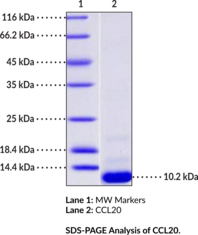
Chemokine (C-C motif) ligand 20 (CCL20) is a cytokine of the C-C motif chemokine family.1 CCL20 is a monomer comprised of an N-terminal region, a DCCL motif linked to the first β strand of a three-stranded antiparallel β sheet that forms a loop region, and a C-terminal α helix. The flexible N-terminal and loop regions are important for receptor binding. It is produced as a 96-amino acid precursor protein from which mature CCL20 is formed by proteolytic cleavage of a signal sequence. CCL20 is constitutively expressed primarily in the liver, lung, appendix, and tonsils, as well as in macrophages, dendritic cells, leukocytes, colonic epithelial cells, and keratinocytes. Its expression is induced in response to cytokines, bacteria, and viruses in epithelial cells of the tonsils and lower airway, a variety of immune cells, melanocytes, and dermal fibroblasts. It binds to chemokine (C-C motif) receptor 6 (CCR6) on leukocytes in a cell subtype-, maturation stage-, or differentiation stage-dependent manner and attracts immature dendritic cells or memory T or B cells. CCL20 is overexpressed in a variety of cancer cells and attracts immature dendritic cells to the tumor microenvironment.2 Overexpression of CCL20 in triple-negative breast cancer (TNBC) cells increases proliferation in vitro and increases the tumor growth rate in mouse xenograft models. Its expression is increased in tumor tissue from patients with hepatocellular carcinoma, and the expression level is positively associated with a lower survival rate. CCL20 expression and protein levels are increased in a variety of other diseases, including in skin lesions of patients with atopic dermatitis or psoriasis and in inflamed-joint synovial fluid from patients with rheumatoid arthritis.1 Cayman’s CCL20 (human, recombinant) protein consists of 87 amino acids and has a calculated molecular weight of 10.2 kDa.
WARNING This product is not for human or veterinary use.
References & Product Citations
1. The CC chemokine CCL20 and its receptor CCR6. Cytokine Growth Factor Rev. 14(5), 409-426 (2003).
2. CCL20 signaling in the tumor microenvironment. Tumor Microenvironments. The Role of Chemokines–Part A 1231, 55-65 (2020).
Contact Info
Cayman Chemical1180 East Ellsworth RoadAnn Arbor, Michigan 48108 USAToll Free: (800) 364-9897(USA and Canada only)Fax: (734) 971-3640


