
Technical Support & Resources
Visit our FAQ
Contact Us
Toll Free Phone (USA and Canada Only): (888) 526-5351
Direct Phone: (734) 975-3888
Product Categories
Product Type
Application
Technical Information
- CD134L
- CD252
- Glycoprotein Gp34
- OX40 Ligand
- OX40L
- TAX Transcriptionally Activated Glycoprotein 1
- Tumor Necrosis Factor Ligand Superfamily Member 4
- TXGP1
Shipping & Storage Information
Recommended Products
Certificates of Analysis & Batch Specific Data
Provide batch numbers separated by commas to download or request available product inserts, QC sheets, certificates of analysis, data packs, and GC-MS data.
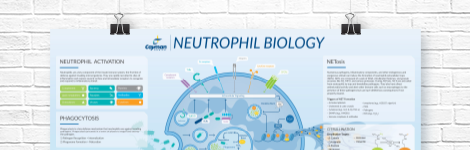
Neutrophil Biology Wall Poster
Explore how neutrophils shape the immune response in health and disease. This poster highlights neutrophil pathogen defense mechanisms, including phagocytosis, degranulation, and NETosis, as well as neutrophil roles in inflammation and NET-associated pathologies.
DOWNLOAD NOWProduct Description
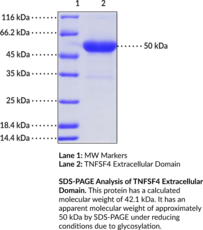
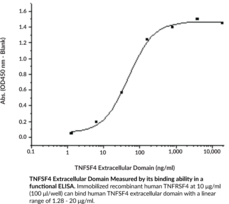
TNF ligand superfamily member 4 (TNFSF4), also known as OX40L, is a type II transmembrane protein and the cognate ligand of the T cell co-stimulatory TNF receptor TNFRSF4, also known as OX40.1,2 TNFSF4 assembles into trimers, with each monomer possessing an approximately 132-amino acid extracellular domain comprised of a TNF homology domain followed by a C-terminal extension. It is upregulated in antigen-presenting cells, including B cells, macrophages, and dendritic cells, in response to antigen presentation, and is also expressed in mast cells, activated T cells, and certain endothelial cells.2 Binding of a TNFSF4 trimer to three TNFRSF4 monomers promotes T cell survival and memory, as well as an effector T cell phenotype, enhances cell mobility, and increases the production of effector cytokines. Polymorphisms in TNFSF4 are associated with susceptibility to systemic lupus erythematosus (SLE) and systemic sclerosis.3,4 Cayman’s TNFSF4 Extracellular Domain (human, recombinant) protein can be used for ELISA. This protein is a disulfide-lined homodimer. The reduced monomer, comprised of TNFSF4 (amino acids 51-183) fused to mouse IgG1 Fc at its N-terminus, consists of 369 amino acids and has a calculated molecular weight of 42.1 kDa. As a result of glycosylation, the monomer migrates at approximately 50 kDa by SDS-PAGE under reducing conditions.
WARNING This product is not for human or veterinary use.
References & Product Citations
1. The crystal structure of the costimulatory OX40-
2. OX40, OX40L and autoimmunity: A comprehensive review. Clin. Rev. Allergy Immunol. 50(3), 312-332 (2016).
3. Associations between TNFSF4 and TRAF1-
4. Association of TNFSF4 (OX40L) polymorphisms with susceptibility to systemic sclerosis. Ann. Rheum. Dis. 69(3), 550-555 (2010).
Contact Info
Cayman Chemical1180 East Ellsworth RoadAnn Arbor, Michigan 48108 USAToll Free: (800) 364-9897(USA and Canada only)Fax: (734) 971-3640


