
Technical Support & Resources
Visit our FAQ
Contact Us
Toll Free Phone (USA and Canada Only): (888) 526-5351
Direct Phone: (734) 975-3888
Product Categories
Product Type
Technical Information
- Vascular Endothelial Growth Factor A 164 variant
Shipping & Storage Information
Recommended Products
Certificates of Analysis & Batch Specific Data
Provide batch numbers separated by commas to download or request available product inserts, QC sheets, certificates of analysis, data packs, and GC-MS data.

Visit Our Cancer Resource Center
Find Tools & Resources to Study the Hallmarks of Cancer
- Cancer cell signaling & regulation
- Cancer metabolism
- Tumor microenvironment
Product Description
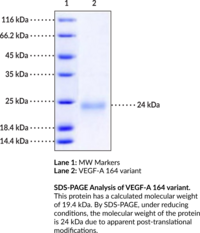
VEGF-A is a member of the PDGF/VEGF family of growth factors that regulates development, proliferation, and maintenance of the vascular system.1 Alternative splicing of Vegfa pre-mRNA leads to the formation of VEGF-A 164 variant (VEGF-164), an isoform of VEGF-A that contains two heparin binding domains that interact with VEGFR1 and VEGFR2, the VEGFR co-receptors neuropilin-1 (NRP1) and NRP2, and matrix-associated glycosaminoglycans.2,3 VEGF-164 exists as a secreted or matrix-bound homodimer and is expressed in the brain, bone, eye, heart, lung, kidney and liver.4,5 Transgenic overexpression of VEGF-164 in the podocytes of mice induces complete collapse of the glomerular capillary network and is perinatal lethal.6 Inhibition of VEGF-164 with a neutralizing aptamer inhibits leukocyte adhesion and neovascularization in the retina in a rat model of hyperoxia-induced proliferative retinopathy.7 Serum levels of the human homolog VEGF-165 are increased in patients with melanoma and positively correlated with metastasis.8 VEGF-165 levels are also increased in the serum, synovial fluid, and inflamed joints of patients with rheumatoid arthritis.9 Cayman's VEGF-A 164 variant (mouse, recombinant) protein can be used for cell-based assay applications. This protein consists of 164 amino acids, has a calculated molecular weight of 19.4 kDa, and a predicted N-terminus of Ala27 after signal peptide cleavage. By SDS-PAGE, under reducing conditions, the molecular weight of the protein is 24 kDa due to apparent post-translational modifications.
WARNING This product is not for human or veterinary use.
References & Product Citations
1. Vascular endothelial growth factor (VEGF) and its receptor (VEGFR) signaling in angiogenesis: A crucial target for anti-
2. The vascular endothelial growth factor (VEGF) family: Angiogenic factors in health and disease. Genome Biol. 6(2), 209 (2005).
3. Molecular mapping and functional characterization of the VEGF164 heparin-
4. Impaired myocardial angiogenesis and ischemic cardiomyopathy in mice lacking the vascular endothelial growth factor isoforms VEGF164 and VEGF188. Nat. Med. 5(5), 495-502 (1999).
5. Autocrine VEGF isoforms differentially regulate endothelial cell behavior. Front. Cell. Dev. Biol. 4, 99 (2016).
6. Glomerular-
7. VEGF164-
8. VEGF-
9. Proinflammatory role of vascular endothelial growth factor in the pathogenesis of rheumatoid arthritis: Prospects for therapeutic intervention. Mediators Inflamm. 129873 (2008).
Contact Info
Cayman Chemical1180 East Ellsworth RoadAnn Arbor, Michigan 48108 USAToll Free: (800) 364-9897(USA and Canada only)Fax: (734) 971-3640


