
Technical Support & Resources
Visit our FAQ
Contact Us
Toll Free Phone (USA and Canada Only): (888) 526-5351
Direct Phone: (734) 975-3888
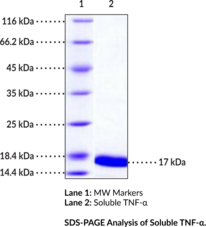
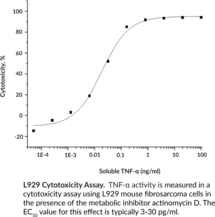
Technical Information
- DIF
- Differentiation-inducing Factor
- TNFA
- TNFSF2
- Tumor Necrosis Factor-α
Shipping & Storage Information
Recommended Products
Certificates of Analysis & Batch Specific Data
Provide batch numbers separated by commas to download or request available product inserts, QC sheets, certificates of analysis, data packs, and GC-MS data.

Visit Our Cancer Resource Center
Find Tools & Resources to Study the Hallmarks of Cancer
- Cancer cell signaling & regulation
- Cancer metabolism
- Tumor microenvironment
Product Description
TNF-α is a cytokine and a member of the TNF/TNF receptor (TNFR) cytokine superfamily.1 TNF-α is produced as a 233-amino acid transmembrane precursor protein from which mature, soluble TNF-α is formed by proteolysis.2 Soluble TNF-α is a 157-amino acid polypeptide, cleaved from the precursor protein on the extracellular side of the membrane, that forms bell-shaped homotrimers with the C-termini at the base, each containing three receptor interaction sites.3 It is primarily produced by activated macrophages but can also be produced by a variety of other cells, such as T cells, natural killer cells, and osteoblasts.3,4 TNF-α binds to and activates its receptors, TNFR1 and TNFR2, which are associated with intracellular protein complexes that activate caspases to induce cell death, induce p38 MAPK signaling, and initiate NF-κB or AP-1-mediated transcription of immune and inflammatory mediators.5 TNF-α promotes inflammation partly by inducing endothelial cells to express adhesion molecules, COX enzymes, and pro-coagulant factors.4 Exogenous TNF-α induces death of cancer cells in vitro, as well as disrupts tumor vascularization and induces necrosis in vivo, but it has tumor promoting properties when produced in the cancer microenvironment.6,1 In contrast, it plays a role in resistance to infection, with mice lacking Tnf having an increased susceptibility to certain microbial infections but lacking resistance to leishmania.5 Tnf knockout mice are also resistant to certain types of cancer, including chemically induced skin carcinogenesis.1 TNF-α increases lung metastases in a mouse model of fibrosarcoma, an effect that can be reduced by an anti-TNF-α antibody. Mice overexpressing Tnf develop an arthritis similar to rheumatoid arthritis in humans.7 TNF-α is produced in the inflamed tissues of patients with inflammatory diseases such as rheumatoid arthritis, and neutralizing antibodies to TNF-α reduce the levels of TNF-α in vitro and in mouse models of the disease.4 Cayman’s Soluble TNF-α (mouse, recombinant) protein can be used for cell-based assay applications. This protein consists of 157 amino acids and has a calculated molecular weight of 17 kDa.
WARNING This product is not for human or veterinary use.
References & Product Citations
1. TNF-
2. A novel form of TNF/cachectin is a cell surface cytotoxic transmembrane protein: Ramifications for the complex physiology of TNF. Cell 53(1), 45-53 (1988).
3. Human pro-
4. TNF-
5. TNFα and the TNF receptor superfamily: Structure-
6. Unleashing endogenous TNF-
7. The TNF-
Contact Info
Cayman Chemical1180 East Ellsworth RoadAnn Arbor, Michigan 48108 USAToll Free: (800) 364-9897(USA and Canada only)Fax: (734) 971-3640


