
Technical Support & Resources
Visit our FAQ
Contact Us
Toll Free Phone (USA and Canada Only): (888) 526-5351
Direct Phone: (734) 975-3888
Product Categories
Product Type
Application
Technical Information
- Cluster of Differentiation 226
- DNAX Accessory Molecule-1
- DNAM-1
- PTA1
- TLISA1
Shipping & Storage Information
Recommended Products
Certificates of Analysis & Batch Specific Data
Provide batch numbers separated by commas to download or request available product inserts, QC sheets, certificates of analysis, data packs, and GC-MS data.

Visit Our Cancer Resource Center
Find Tools & Resources to Study the Hallmarks of Cancer
- Cancer cell signaling & regulation
- Cancer metabolism
- Tumor microenvironment
Product Description
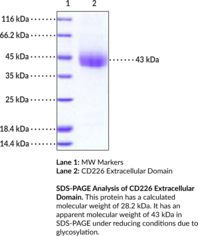
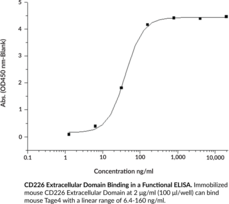
CD226, also known as DNAM-1, is a type I transmembrane glycoprotein and a member of the immunoglobulin superfamily.1 It is composed of an N-terminal signal peptide, an extracellular domain containing two immunoglobulin-like (Ig-like) domains and two paired cysteine residues, a transmembrane domain, and a C-terminal cytoplasmic region containing at least two phosphorylation sites important for ligand binding.1,2 It is expressed on certain T cells, natural killer (NK) cells, monocytes, and B cells and mediates cell adhesion between these and other immune cells.1 CD226 is an adhesion protein that binds to its ligands, PVR/CD155 or nectin-2/CD112, expressed on immature dendritic cells, as well as infected or transformed cells, to induce NK-mediated killing and cell lysis.2 CD226 also associates with lymphocyte function-associated antigen 1 (LFA1) on activated NK cells, which is essential for its signaling.3 A variant of Cd226 generated through alternative splicing in mice lacks the first Ig-like domain and does not interact with CD155.2 In addition, mouse Cd226 interacts with mouse, but not human, CD155.4 CD226 is involved in immunological synapse formation and acts as a co-stimulatory molecule on NK cells to promote antigen presenting cell-induced cytokine release that, in turn, induces IFN-γ secretion from NK cells.2 It is also involved in NK cell-mediated immunosurveillance, reducing tumor growth in mouse models of cancer while Cd226-/- mice are more susceptible to NK cell-dependent tumor initiation.2,5 A glycine-to-serine mutation at position 307 of CD226 is associated with autoimmune diseases, such as rheumatoid arthritis, systemic lupus erythematosus (SLE), and multiple sclerosis.2,6 Cayman’s CD226 Extracellular Domain (mouse, recombinant; His-tagged) protein can be used for binding assay and ELISA applications. This protein consists of 247 amino acids, has a calculated molecular weight of 28.2 kDa, and a predicted N-terminus of Glu19 after signal peptide cleavage. By SDS-PAGE, under reducing conditions, the apparent molecular mass of the protein is 43 kDa due to glycosylation.
WARNING This product is not for human or veterinary use.
References & Product Citations
1. DNAM-
2. Balancing natural killer cell activation through paired receptors. Nat. Rev. Immunol. 15(4), 243-254 (2015).
3. Physical and functional association of LFA-
4. Mouse TIGIT inhibits NK-
5. NCRs and DNAM-
6. CD226 Gly307Ser association with multiple autoimmune diseases. Genes Immun. 10(1), 5-10 (2008).
Contact Info
Cayman Chemical1180 East Ellsworth RoadAnn Arbor, Michigan 48108 USAToll Free: (800) 364-9897(USA and Canada only)Fax: (734) 971-3640


