
Technical Support & Resources
Visit our FAQ
Contact Us
Toll Free Phone (USA and Canada Only): (888) 526-5351
Direct Phone: (734) 975-3888
Product Categories
Product Type
Application

Technical Information
- IAP
- Integrin-associated Protein
- Integrin-associated Signal Transducer
- Leukocyte Surface Antigen CD47
Shipping & Storage Information
Recommended Products
Certificates of Analysis & Batch Specific Data
Provide batch numbers separated by commas to download or request available product inserts, QC sheets, certificates of analysis, data packs, and GC-MS data.

Visit Our Cancer Resource Center
Find Tools & Resources to Study the Hallmarks of Cancer
- Cancer cell signaling & regulation
- Cancer metabolism
- Tumor microenvironment
Product Description
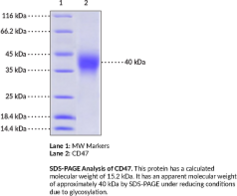
CD47 is a transmembrane protein and ligand for signal regulatory protein α (SIRPα; Item No. 32082) with roles in phagocytosis, cell adhesion, and migration.1 It is composed of five transmembrane regions and a single immunoglobulin-like (Ig-like) domain that interacts with the amino terminus of SIRPα to induce inhibitory signaling and prevent phagocytosis. CD47 is expressed on all cells, including erythrocytes and platelets, but the levels of expression on immune cells fluctuates in an immune status- or disease-dependent manner. It interacts with certain integrins and functions as a receptor for the extracellular matrix protein thrombospondin. CD47 is overexpressed in various cancer cells, and anti-CD47 antibodies enhance macrophage phagocytosis of tumor cells in vitro.2 Cd47-/- mice exhibit defective mucosal repair after intestinal biopsy or intestinal mucosal damage induced by dextran sulfate sodium (DSS; Item No. 23250).3 Knockout of Cd47 also decreases infarct volume and hemispheric swelling in a mouse model of transient focal cerebral ischemia.4 It also decreases sensorimotor function deficits, brain lesion volume, and neutrophil infiltration, as well as increases brain blood vessel density in a mouse model of traumatic brain injury.5 Cayman's CD47 (human, recombinant) protein can be used for ELISA. This protein consists of 132 amino acids, has a calculated molecular weight of 15.2 kDa, and a predicted N-terminus of Gln19 after signal peptide cleavage. By SDS-PAGE, under reducing conditions, the apparent molecular mass of the protein is approximately 40 kDa due to glycosylation.
WARNING This product is not for human or veterinary use.
References & Product Citations
1. The interaction between signal regulatory protein alpha (SIRPα) and CD47: Structure, function, and therapeutic target. Annu. Rev. Immunol. 32, 25-50 (2014).
2. SIRPα-
3. Epithelial CD47 is critical for mucosal repair in the murine intestine in vivo. Nat. Commun. 10(1), 5004 (2019).
4. CD47 gene knockout protects against transient focal cerebral ischemia in mice. Exp. Neurol. 217(1), 165-170 (2009).
5. CD47 deficiency improves neurological outcomes of traumatic brain injury in mice. Neurosci. Lett. 643, 125-130 (2016).
Contact Info
Cayman Chemical1180 East Ellsworth RoadAnn Arbor, Michigan 48108 USAToll Free: (800) 364-9897(USA and Canada only)Fax: (734) 971-3640


