
Technical Support & Resources
Visit our FAQ
Contact Us
Toll Free Phone (USA and Canada Only): (888) 526-5351
Direct Phone: (734) 975-3888
Product Categories
Product Type
Application
Technical Information
- Iduronate 2-Sulfatase
- α-L-Iduronate Sulfate Sulfatase
- Idursulfase
Shipping & Storage Information
Recommended Products
Certificates of Analysis & Batch Specific Data
Provide batch numbers separated by commas to download or request available product inserts, QC sheets, certificates of analysis, data packs, and GC-MS data.
Product Description
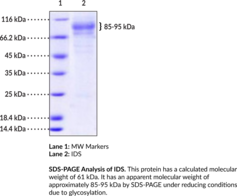
Iduronate 2-sulfatase (IDS) is a lysosomal exohydrolase belonging to the sulfatase family and is required for the degradation of the glycosaminoglycans heparan sulfate and dermatan sulfate.1,2 IDS is synthesized as a 550-amino acid precursor comprised of an N-terminal signal peptide and propeptide that are cleaved during secretion and maturation, followed by two subdomains, SD1, which contains the catalytic core, and the catalytically-inactive SD2.2,3,4 SD1 and SD2 can be separated by proteolytic cleavage and remain stably associated in an enzymatically active form. IDS is highly expressed in the brain, particularly in the cortex, amygdala, hippocampus, hypothalamus, and basal ganglia, with lower levels observed in the cerebellum and spinal cord.3 Mutations in IDS resulting in IDS functional deficiencies cause Hunter syndrome, also known as mucopolysaccharidosis type II (MPS II), an X-linked lysosomal storage disease.1,2 Formulations containing recombinant human IDS have been used in the treatment of Hunter syndrome. Cayman's IDS (human, recombinant) protein can be used for enzyme activity assay applications. This protein consists of 536 amino acids, has a calculated molecular weight of 61 kDa, and a predicted N-terminus of Ser26 after signal peptide cleavage. By SDS-PAGE, under reducing conditions, the protein migrates as several bands with apparent molecular masses of 85 to 95 kDa due to glycosylation.
WARNING This product is not for human or veterinary use.
References & Product Citations
1. Sequence of the human iduronate 2-
2. Insights into Hunter syndrome from the structure of iduronate-
3. Comparative studies of vertebrate iduronate 2-
4. Hunter syndrome: Isolation of an iduronate-
Contact Info
Cayman Chemical1180 East Ellsworth RoadAnn Arbor, Michigan 48108 USAToll Free: (800) 364-9897(USA and Canada only)Fax: (734) 971-3640


