
Technical Support & Resources
Visit our FAQ
Contact Us
Toll Free Phone (USA and Canada Only): (888) 526-5351
Direct Phone: (734) 975-3888
Product Categories
Product Type
Application
Technical Information
- Activin β-A Chain
- Follicle-Stimulating Hormone-Releasing Protein
- Inhibin β-A Chain
- Inhibin Subunit β A
Shipping & Storage Information
Recommended Products
Certificates of Analysis & Batch Specific Data
Provide batch numbers separated by commas to download or request available product inserts, QC sheets, certificates of analysis, data packs, and GC-MS data.

Visit Our Cancer Resource Center
Find Tools & Resources to Study the Hallmarks of Cancer
- Cancer cell signaling & regulation
- Cancer metabolism
- Tumor microenvironment
Product Description
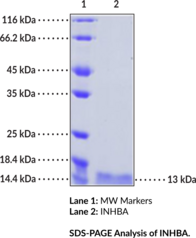
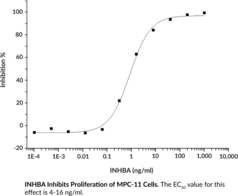
Inhibin subunit β A (INHBA) is a member of the TGF-β superfamily with roles in germ cell maturation.1,2 INHBA encodes a 426-amino acid pre-protein, that which is proteolytically cleaved at Gly311 to release the mature INHBA peptide corresponding to amino acids 311-426. Mature INHBA homodimerizes to form activin A, which has roles in the immune response, cell differentiation, and glucose metabolism, and heterodimerizes with INHBB to form inhibin, a complex that negatively regulates gonadal stromal cell proliferation and has tumor suppressor activity. INHBA is overexpressed in various cancers, including breast, lung, esophageal, bladder, and colorectal cancers, and this overexpression is positively correlated with poor prognosis.2 Expression of INHBA is increased in granulosa cells isolated from women with polycystic ovaries compared with granulosa cells isolated from women with healthy ovaries.3 Germline knockout of Inhba increases skeletal muscle mass in mice.4 Cayman's INHBA (recombinant) protein can be used for cell-based assay applications. This protein consists of 116 amino acids, which correspond to the mature form of human, mouse, and rat, as well as cynomolgus and rhesus monkey, INHBA and has a calculated molecular weight of 13 kDa.
WARNING This product is not for human or veterinary use.
References & Product Citations
1. Drivers of germ cell maturation. Ann. N. Y. Acad. Sci. 1061(1), 173-182 (2005).
2. Targeting INHBA in ovarian cancer cells suppresses cancer xenograft growth by attenuating stromal fibroblast activation. Dis. Markers 7275289 (2019).
3. Gene expression in granulosa cells from small antral follicles from women with or without polycystic ovaries. J. Clin. Endocrinol. Metab. 104(12), 6182-6192 (2019).
4. Genes whose gain or loss-
Contact Info
Cayman Chemical1180 East Ellsworth RoadAnn Arbor, Michigan 48108 USAToll Free: (800) 364-9897(USA and Canada only)Fax: (734) 971-3640


