
Technical Support & Resources
Visit our FAQ
Contact Us
Toll Free Phone (USA and Canada Only): (888) 526-5351
Direct Phone: (734) 975-3888
Product Categories
Product Type
Technical Information
- EPO
- Epoetin
Shipping & Storage Information
Recommended Products
Certificates of Analysis & Batch Specific Data
Provide batch numbers separated by commas to download or request available product inserts, QC sheets, certificates of analysis, data packs, and GC-MS data.
Product Description
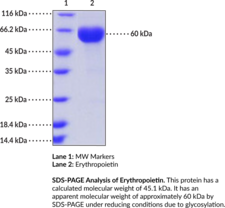
Erythropoietin is a glycoprotein and growth factor encoded by EPO in humans that is essential for erythropoiesis.1 It undergoes co-translational cleavage to remove the 27-amino acid leader sequence and can undergo post-translational cleavage to remove Arg193 to generate des-Arg erythropoietin, which has been found in the circulation.2,3 Mature erythropoietin is a single-chain polypeptide consisting of a 50% helical structure in a globular conformation and contains three N-linked and one O-linked carbohydrate.1,3 It is primarily produced in the kidney, and to a lesser extent in the liver, at low levels under homeostatic conditions, but production is increased in response to erythropoietic stress such as hypoxia or anemia.4 Erythropoietin binds to the erythropoietin receptor on immature erythrocytes in the bone marrow to induce erythrocyte production. Knockdown of Epo induces severe anemia, ventricular hypoplasia, and death at an early embryonic age in mice.5 Exogenous administration of erythropoietin reduces left ventricular end diastolic pressure and cardiomyocyte loss in a rat model of ischemia-reperfusion injury induced by coronary artery occlusion. It also increases cardiac neovascularization and decreases cardiac fibrosis in various animal models of myocardial infarction. Formulations containing recombinant human erythropoietin have been used in the treatment of chronic kidney disease-induced anemia. Cayman's Erythropoietin (human, recombinant) protein is a disulfide-linked homodimer. The reduced monomer, composed of erythropoietin (amino acids 28-193) fused to human IgG1 Fc at its C-terminus, consists of 404 amino acids, has a calculated molecular weight of 45.1 kDa, and a predicted N-terminus of Ala28 after signal peptide cleavage. As a result of glycosylation, the monomer migrates at approximately 60 kDa by SDS-PAGE under reducing conditions.
WARNING This product is not for human or veterinary use.
References & Product Citations
1. Erythropoietin. Annu. Rev. Nutr. 15, 353-377 (1995).
2. Structural characterization of natural human urinary and recombinant DNA-
3. Erythropoietin: Structure, control of production, and function. Physiol. Rev. 72(2), 449-489 (1992).
4. The erythropoietin receptor: Molecular structure and hematopoietic signaling pathways. J. Investig. Med. 59(7), 1067-1072 (2011).
5. Is there a role for erythropoietin in cardiovascular disease? Expert Opin. Biol. Ther. 10(2), 251-264 (2010).
Contact Info
Cayman Chemical1180 East Ellsworth RoadAnn Arbor, Michigan 48108 USAToll Free: (800) 364-9897(USA and Canada only)Fax: (734) 971-3640


