
Technical Support & Resources
Visit our FAQ
Contact Us
Toll Free Phone (USA and Canada Only): (888) 526-5351
Direct Phone: (734) 975-3888
Product Categories
Product Type
Application
Technical Information
- Chemokine (C-X-C motif) Ligand 12
- Intercrine Reduced in Hepatomas
- Pre-B Cell Growth-stimulating Factor
- SDF-1
- Stromal Cell-derived Factor 1
Shipping & Storage Information
Recommended Products
Certificates of Analysis & Batch Specific Data
Provide batch numbers separated by commas to download or request available product inserts, QC sheets, certificates of analysis, data packs, and GC-MS data.
Product Description
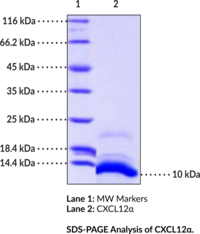
Chemokine (C-X-C motif) ligand 12 (CXCL12) is a homeostatic chemokine and member of the CXC chemokine subfamily.1 Alternative splicing of CXCL12 produces six isoforms that exhibit isoform-specific tissue distribution.2 CXCL12α is ubiquitously expressed and is composed of an N-terminal receptor binding domain, a glycosaminoglycan-binding domain, and a C-terminal domain.1,2 CXCL12α binds to atypical chemokine receptor 3 (ACKR3) and chemokine (C-X-C motif) receptor 4 (CXCR4) to induced β-arrestin and G protein-coupled receptor signaling, respectively.1 It enhances hematopoietic progenitor cell survival and chemotaxis.3 CXCL12α promotes axonal elongation of primary spinal cord motor neurons and administration of an anti-Cxcl12α antibody delays neuromuscular nerve junction regeneration in a mouse model of α-latrotoxin-induced neuromuscular degeneration.4 Cayman's CXCL12α (human, recombinant) protein consists of 84 amino acids and has a calculated molecular weight of 10 kDa.
WARNING This product is not for human or veterinary use.
References & Product Citations
1. The unique structural and functional features of CXCL12. Cell. Mol. Immunol. 15(4), 299-311 (2018).
2. Identification and expression of novel isoforms of human stromal cell-
3. A naturally occurring splice variant of CXCL12/stromal cell-
4. CXCL12α/SDF-
Contact Info
Cayman Chemical1180 East Ellsworth RoadAnn Arbor, Michigan 48108 USAToll Free: (800) 364-9897(USA and Canada only)Fax: (734) 971-3640


