
Technical Support & Resources
Visit our FAQ
Contact Us
Toll Free Phone (USA and Canada Only): (888) 526-5351
Direct Phone: (734) 975-3888
Decorin Long Isoform (human, recombinant)
Item No. 32095
Technical Information
- Bone Proteoglycan II
- PG-S2
- PG-40
- PG-II
Shipping & Storage Information
Recommended Products
Certificates of Analysis & Batch Specific Data
Provide batch numbers separated by commas to download or request available product inserts, QC sheets, certificates of analysis, data packs, and GC-MS data.

Visit Our Cancer Resource Center
Find Tools & Resources to Study the Hallmarks of Cancer
- Cancer cell signaling & regulation
- Cancer metabolism
- Tumor microenvironment
Product Description
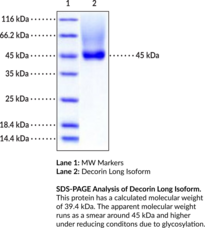
Decorin is an extracellular matrix protein and member of the leucine-rich proteoglycan family that influences many cellular functions, including adhesion, growth, differentiation, proliferation, and survival.1,2 Alternative splicing of DCN pre-mRNA generates five isoforms of varying length.3 Decorin contains a core protein that mediates ligand binding and is composed of a cysteine-rich domain covalently linked to a chondroitin or dermatan sulfate glycosaminoglycan chain and a leucine-rich repeat (LRR) domain that can bind up to three N-linked oligosacchaides.4,5 The core protein is flanked by an N-terminal signal peptide and propeptide domain, which regulate decorin secretion, and a C-terminal domain that is truncated in mutant forms of DCN. Decorin is secreted as a monomer and expressed by endothelial cells and cancer cells in a variety of tissues.1 It is induced by autophagic stimuli, including mTOR inhibition and nutrient deprivation, and downregulated by the adhesion protein periostin.6,7 Decorin binds to and sequesters a variety of molecules, including extracellular matrix proteins, growth factors and their receptors, cytokines, enzymes, hormones, and lipoproteins.4 It also enhances integrin-collagen interactions, promoting angiogenesis.8 Intravenous administration of the decorin core protein reduces tumor growth and lung metastases in an MTLn3 mouse xenograft model.9 Decreased decorin tumor levels are associated with low disease-free and overall survival rates in patients with spindle cell sarcomas.8 Frameshift mutations in DCN have been associated with congenital stromal corneal dystrophy, a condition characterized by corneal opacity.5 Cayman's Decorin Long Isoform (human, recombinant) protein consists of 354 amino acids, has a calculated molecular weight of 39.4 kDa, and a predicted N-terminus of Gly17 after signal peptide cleavage. Differential glycosylation of decorin results in the presence of multiple protein bands causing the observed smear at approximately 45 kDa and higher when observed by SDS-PAGE under reducing conditions.
WARNING This product is not for human or veterinary use.
References & Product Citations
1. Decorin is a pivotal effector in the extracellular matrix and tumour microenvironment. Oncotarget 9(4), 5480-5491 (2018).
2. Decorin: A guardian from the matrix. Am. J. Pathol. 181(2), 380-387 (2012).
3. Bone matrix and mineralization. Pediatric Bone 9-37 (2012).
4. Decorin-
5. Congenital stromal dystrophy of the cornea caused by a mutation in the decorin gene. Invest. Ophthalmol. Vis. Sci. 46(2), 420-426 (2005).
6. Decorin is an autophagy-
7. Periostin suppression induces decorin secretion leading to reduced breast cancer cell motility and invasion. Sci. Rep. 4, 7069 (2014).
8. Biological functions of decorin in cancer. Chin. J. Cancer 32(5), 266-269 (2013).
9. An antimetastatic role for decorin in breast cancer. Am. J. Pathol. 173(3), 844-855 (2008).
Contact Info
Cayman Chemical1180 East Ellsworth RoadAnn Arbor, Michigan 48108 USAToll Free: (800) 364-9897(USA and Canada only)Fax: (734) 971-3640


