
Technical Support & Resources
Visit our FAQ
Contact Us
Toll Free Phone (USA and Canada Only): (888) 526-5351
Direct Phone: (734) 975-3888
Technical Information
- Immunoglobulin D
Shipping & Storage Information
Recommended Products
Certificates of Analysis & Batch Specific Data
Provide batch numbers separated by commas to download or request available product inserts, QC sheets, certificates of analysis, data packs, and GC-MS data.

Visit Our Cancer Resource Center
Find Tools & Resources to Study the Hallmarks of Cancer
- Cancer cell signaling & regulation
- Cancer metabolism
- Tumor microenvironment
Product Description
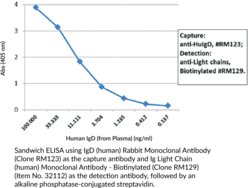
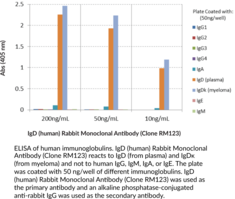
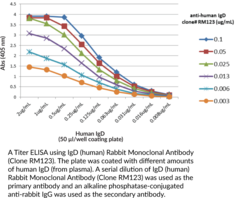
Immunoglobulin D (IgD) is a member of the immunoglobulin superfamily of glycoproteins that functions as a B cell antigen receptor (BCR) and has roles in adaptive immunity.1 Human IgD is composed of two Igδ heavy chains of approximately 50 kDa each and two Igĸ or Igλ light chains of approximately 25 kDa each.2,3 It is expressed on the surface of antigen-naïve mature B cells, which are found in germinal centers and peripheral blood, as well as certain subsets of circulating memory B cells.1,4 IgD levels increase during B cell maturation and are regulated by alternative splicing of an mRNA transcript that is common to the µ and δ heavy chains of IgM and IgD, respectively.1,5 Upon antigen activation, IgD can undergo class switch recombination to the immunoglobulin isotypes IgA, IgE, or IgG, each of which has a distinct effector function.6 IgD can also be produced from IgM by class switch recombination, leading to the generation of IgD-secreting plasma cells that have roles in mucosal immunity.7 IgD binds to basophil and mast cell lines, as well as the respiratory pathogens M. catarrhalis and H. influenzae, in vitro.8 Serum IgD levels are increased in patients with a variety of conditions, including leprosy, tuberculosis, malaria, or Hodgkin's lymphoma and is a hallmark of hyperimmunoglobulinemia D syndrome (HIDS), an autoinflammatory condition characterized by febrile episodes.9 Cayman's IgD (human) Rabbit Monoclonal Antibody (Clone RM123) can be used for ELISA.
WARNING This product is not for human or veterinary use.
References & Product Citations
1. The enigmatic function of IgD: Some answers at last. Eur. J. Immunol. 48(7), 1101-1113 (2018).
2. Structural and functional properties of membrane and secreted IgD. Mol. Immunol. 37(15), 871-887 (2000).
3. Structure and function of immunoglobulins. J. Allergy Clin. Immunol. 125(2 Suppl. 2), S41-S52 (2010).
4. Human memory B cells. Leukemia 30(12), 2283-2292 (2016).
5. The riddle of the dual expression of IgM and IgD. Immunology 118(4), 429-437 (2006).
6. IgH chain class switch recombination: mechanism and regulation. J. Immunol. 193(11), 5370-5378 (2014).
7. The function and regulation of immunoglobulin D. Curr. Opin. Immunol. 23(3), 345-352 (2011).
8. Immunoglobulin D enhances immune surveillance by activating antimicrobial, proinflammatory and B cell–stimulating programs in basophils. Nat. Immunol. 10(8), 889-898 (2009).
9. Immunoglobulin D: Properties, measurement, and clinical relevance. Clin. Diagn. Lab Immunol. 7(2), 131-140 (2000).
Contact Info
Cayman Chemical1180 East Ellsworth RoadAnn Arbor, Michigan 48108 USAToll Free: (800) 364-9897(USA and Canada only)Fax: (734) 971-3640


