
Technical Support & Resources
Visit our FAQ
Contact Us
Toll Free Phone (USA and Canada Only): (888) 526-5351
Direct Phone: (734) 975-3888
Product Categories

Technical Information
- Monomethylated Histone H3 Lysine 9
Shipping & Storage Information
Recommended Products
Certificates of Analysis & Batch Specific Data
Provide batch numbers separated by commas to download or request available product inserts, QC sheets, certificates of analysis, data packs, and GC-MS data.

Visit Our Cancer Resource Center
Find Tools & Resources to Study the Hallmarks of Cancer
- Cancer cell signaling & regulation
- Cancer metabolism
- Tumor microenvironment
Product Description
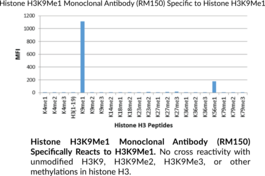
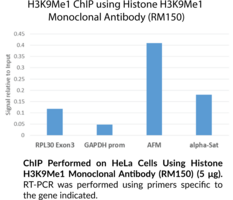
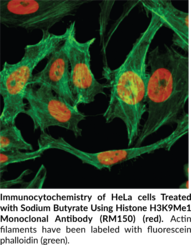
Histone H3 is a nuclear protein and a component of the nucleosome core, a basic unit of chromatin, that is essential for organizing genomic DNA in eukaryotic nuclei.1 It is a globular protein that contains an unstructured N-terminal tail that extends outside of the nucleosome core and is subject to various post-translational modifications (PTMs), including methylation, phosphorylation, acetylation, and citrullination.1,2 Monomethylation of histone H3 at lysine 9 (H3K9Me1) is found at euchromatin regions of silenced genes and is correlated with gene repression.3 Recognition of H3K9Me1 by the H3K9 demethylases GLP and G9a is essential to embryonic stem cell differentiation and viability in mice.4 Cytoplasmic localization of H3K9Me1 is associated with reduced disease-specific mortality risk in patients with oral and/or oropharyngeal squamous cell carcinoma.5 Cayman's Histone H3K9Me1 Monoclonal Antibody (RM150) can be used for chromatin immunoprecipitation (ChIP), ELISA, immunocytochemistry (ICC), multiplex-based assay, and Western blot (WB) applications.
WARNING This product is not for human or veterinary use.
References & Product Citations
1. Writing, erasing and reading histone lysine methylations. Exp. Mol. Med. 49(4), e324 (2017).
2. Histone posttranslational modifications: Potential role in diagnosis, prognosis, and therapeutics of cancer. Prognostic Epigenetics 15, 351-373 (2019).
3. Histone H3 lysine 4 monomethylation (H3K4me1) and H3 lysine 9 monomethylation (H3K9me1): Distribution and their association in regulating gene expression under hyperglycaemic/hyperinsulinemic conditions in 3T3 cells. Biochimie 94(12), 2656-2664 (2012).
4. Recognition of H3K9 methylation by GLP is required for efficient establishment of H3K9 methylation, rapid target gene repression, and mouse viability. Genes Dev. 29(4), 379-393 (2015).
5. JMJD1A, H3K9me1, H3K9me2 and ADM expression as prognostic markers in oral and oropharyngeal squamous cell carcinoma. PLoS One 13(3), e019884 (2018).
Contact Info
Cayman Chemical1180 East Ellsworth RoadAnn Arbor, Michigan 48108 USAToll Free: (800) 364-9897(USA and Canada only)Fax: (734) 971-3640


