
Technical Support & Resources
Visit our FAQ
Contact Us
Toll Free Phone (USA and Canada Only): (888) 526-5351
Direct Phone: (734) 975-3888
Product Categories

Technical Information
- H4pS1
- H4pSer1
- Histone H4 (Phospho-Ser1)
- Phospho-Histone H4 Serine 10
- Phosphorylated Histone H4 Serine 1
Shipping & Storage Information
Recommended Products
Certificates of Analysis & Batch Specific Data
Provide batch numbers separated by commas to download or request available product inserts, QC sheets, certificates of analysis, data packs, and GC-MS data.
Product Description
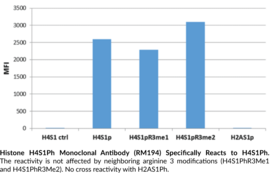
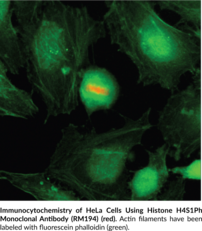
Histone H4 is one of four core histone proteins that are involved in the organization of DNA into chromatin.1 Histones are globular proteins with unstructured N-terminal tails and are subject to a variety of post-translational modifications, such as methylation, acetylation, phosphorylation, and citrullination, that can influence chromatin structure and regulate gene transcription.1,2 Phosphorylation of histone H4 at serine 1 (H4S1Ph) is increased during the S-phase and mitosis in HeLa cells, C. elegans, and Drosophila, as well as during spermatogenesis in mice.3,4 MG-63 cells expressing a serine-to-alanine substitution at Ser1 in histone H4, which abolishes its phosphorylation, have reduced markers of autophagy. Cayman's Histone H4S1Ph Monoclonal Antibody (RM194) can be used for ELISA, immunocytochemistry (ICC), multiplex-based assays, and Western blot (WB) applications.
WARNING This product is not for human or veterinary use.
References & Product Citations
1. Histone hypercitrullination mediates chromatin decondensation and neutrophil extracellular trap formation. J. Cell Biol. 184(2), 205-213 (2009).
2. Writing, erasing and reading histone lysine methylations. Exp. Mol. Med. 49(4), e324 (2017).
3. The enhancement of histone H4 and H2A serine 1 phosphorylation during mitosis and S-
4. Phosphorylation of histone H4 Ser1 regulates sporulation in yeast and is conserved in fly and mouse spermatogenesis. Genes Dev. 20(18), 2580-2592 (2006).
Contact Info
Cayman Chemical1180 East Ellsworth RoadAnn Arbor, Michigan 48108 USAToll Free: (800) 364-9897(USA and Canada only)Fax: (734) 971-3640


