
Technical Support & Resources
Visit our FAQ
Contact Us
Toll Free Phone (USA and Canada Only): (888) 526-5351
Direct Phone: (734) 975-3888
Product Categories

Technical Information
- CD340
- Erb-B2 Receptor Tyrosine Kinase 2
- Human Epidermal Growth Factor Receptor 2
- Neu
- Receptor Tyrosine-Protein Kinase ErbB-2
Shipping & Storage Information
Recommended Products
Certificates of Analysis & Batch Specific Data
Provide batch numbers separated by commas to download or request available product inserts, QC sheets, certificates of analysis, data packs, and GC-MS data.

Visit Our Cancer Resource Center
Find Tools & Resources to Study the Hallmarks of Cancer
- Cancer cell signaling & regulation
- Cancer metabolism
- Tumor microenvironment
Product Description
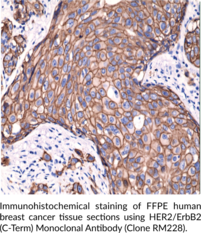
Human epidermal growth factor receptor 2 (HER2), also known as ErbB2 and Neu, is a cell surface receptor and member of the EGF family of receptor tyrosine kinases that is encoded by ERBB2 in humans.1 It is a transmembrane receptor composed of a C-terminal intracellular tyrosine kinase domain, a transmembrane lipophilic segment, and an N-terminal extracellular domain, that is expressed at low levels in various epithelial tissues, as well as breast, lung, kidney, ovary, placenta, and the gastrointestinal tract.2 Unlike other EGF receptors, HER2 does not bind ligands or undergo a conformational change in its extracellular domain for activation. HER2 is activated upon heterodimerization with HER3 or HER4, which stabilizes ligand binding to HER3 and HER4, or homodimerization and enhances kinase-mediated activation of the MAPK and PI3K cellular signaling pathways.1,2 Truncated forms of HER2 with constitutive oncogenic activity can be generated by proteolytic cleavage of the extracellular domain.2 ERBB2 is overexpressed in 12 to 15% of breast cancer tumors and is associated with accelerated growth rate, increased rate of recurrence, and poor overall survival.2 Various mutations in ERBB2, with or without gene amplification, have been found in prostate, colon, bladder, breast, lung, and colorectal tumors, as well as metastatic cutaneous squamous small cell carcinomas.3,4 Cayman's HER2/ErbB2 (C-Term) Monoclonal Antibody (Clone RM228) can be used for immunohistochemistry (IHC) and Western blot (WB) applications.
WARNING This product is not for human or veterinary use.
References & Product Citations
1. Perspectives of HER2-
2. The extracellular domain of Her2 in serum as a biomarker of breast cancer. Lab. Invest. 98(6), 696-707 (2018).
3. Activating HER2 mutations as emerging targets in multiple solid cancers. ESMO Open 2(5), e000279 (2017).
4. Activating HER2 mutations in HER2 gene amplification negative breast cancer. Cancer Discov. 3(2), 224-237 (2013).
Contact Info
Cayman Chemical1180 East Ellsworth RoadAnn Arbor, Michigan 48108 USAToll Free: (800) 364-9897(USA and Canada only)Fax: (734) 971-3640


