
Technical Support & Resources
Visit our FAQ
Contact Us
Toll Free Phone (USA and Canada Only): (888) 526-5351
Direct Phone: (734) 975-3888
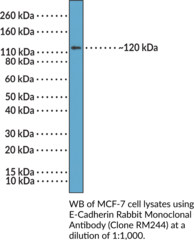
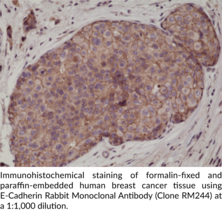
Technical Information
- Cadherin-1
- CDH1
- L-CAM
- Uvomorulin
Shipping & Storage Information
Recommended Products
Certificates of Analysis & Batch Specific Data
Provide batch numbers separated by commas to download or request available product inserts, QC sheets, certificates of analysis, data packs, and GC-MS data.

Visit Our Cancer Resource Center
Find Tools & Resources to Study the Hallmarks of Cancer
- Cancer cell signaling & regulation
- Cancer metabolism
- Tumor microenvironment
Product Description
E-cadherin is a calcium-dependent adhesion molecule that mediates the formation of adherens junctions and regulates epithelial cell integrity and tissue formation.1,2 It is a transmembrane glycoprotein composed of an extracellular cadherin domain that mediates cell-cell interactions, a transmembrane domain, and a cytoplasmic domain that interacts with a variety of adaptor proteins, including β-catenin, to influence cytoskeletal dynamics.3,4 E-cadherin is expressed by epithelial cells and localizes to the cell surface, where it assembles into cis-cadherin dimers that subsequently form trans-cadherin dimers with cadherins expressed on adjacent cells, resulting in cell-cell adhesion.5 E-cadherin cell surface expression is regulated by clathrin-dependent or -independent endocytosis and drives cytoskeletal rearrangements that are necessary for wound closure.6 Loss of E-cadherin is a key feature of the epithelial-to-mesenchymal transition (EMT), a process that promotes tumorigenesis and cancer metastasis.1 Cayman’s E-Cadherin Rabbit Monoclonal Antibody (Clone RM244) can be used for immunohistochemistry (IHC) and Western blot (WB) applications. The antibody recognizes E-cadherin at approximately 120 kDa from human samples.
WARNING This product is not for human or veterinary use.
References & Product Citations
1. Cadherin signaling in cancer: Its functions and role as a therapeutic target. Front Oncol. 9, 989 (2019).
2. The cell-
3. E-
4. Early events in the assembly of E-
5. Interplay between tight junctions & adherens junctions. Exp. Cell Res. 358(1), 39-44 (2017).
6. Adherens junctions on the move-
Contact Info
Cayman Chemical1180 East Ellsworth RoadAnn Arbor, Michigan 48108 USAToll Free: (800) 364-9897(USA and Canada only)Fax: (734) 971-3640


