
Technical Support & Resources
Visit our FAQ
Contact Us
Toll Free Phone (USA and Canada Only): (888) 526-5351
Direct Phone: (734) 975-3888
Product Categories

Technical Information
- MAPK14
- Mitogen-activated Protein Kinase 14
- Mitogen-activated Protein Kinase p38α
- Stress-activated Protein Kinase 2A
Shipping & Storage Information
Recommended Products
Certificates of Analysis & Batch Specific Data
Provide batch numbers separated by commas to download or request available product inserts, QC sheets, certificates of analysis, data packs, and GC-MS data.
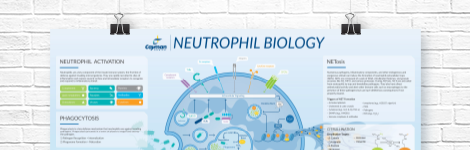
Neutrophil Biology Wall Poster
Explore how neutrophils shape the immune response in health and disease. This poster highlights neutrophil pathogen defense mechanisms, including phagocytosis, degranulation, and NETosis, as well as neutrophil roles in inflammation and NET-associated pathologies.
DOWNLOAD NOWProduct Description
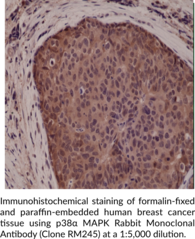
p38 MAPK is a serine/threonine protein kinase and member of the MAPK family with roles in the regulation of immune responses and embryonic development, as well as cell differentiation, metabolism, and survival.1,2 It exists as 4 isoforms, p38α, -β, -γ, and -δ, encoded by MAPK14, MAPK11, MAPK12, and MAPK13, respectively, in humans. p38α MAPK is ubiquitously expressed, with the highest levels of expression in heart, skeletal muscle, and brain.1,3 It is activated via dual phosphorylation of threonine 180 and tyrosine 182 by the MAP2K kinases MKK3 and MKK6 in response to LPS or the production of inflammatory cytokines.1,2 Downstream signaling targets of p38α MAPK include protein kinases, transcription factors, and transcriptional regulators, among others.2 Knockdown of Mapk14 is embryonic lethal, while macrophage-specific deletion of Mapk14 inhibits inflammatory cytokine production and is protective against cecal ligation and puncture-induced sepsis in mice.2,3 Mapk14 knockdown also increases lysosomal degradation of β-secretase 1 (BACE1) and decreases amyloid-β (Aβ) production in the APP/PS1 double transgenic mouse model of Alzheimer's disease.4 Cayman's p38α MAPK Monoclonal Antibody (Clone RM245) can be used for immunohistochemistry (IHC) and Western blot (WB) applications. The antibody recognizes p38α MAPK at approximately 38 kDa from human samples.
WARNING This product is not for human or veterinary use.
References & Product Citations
1. Recent advances in the inhibition of p38 MAPK as a potential strategy for the treatment of Alzheimer’s disease. Molecules 22(8), 1287 (2017).
2. An overview of mammalian p38 mitogen-
3. The p38 MAP kinase family as regulators of proinflammatory cytokine production in degenerative diseases of the CNS. Aging Dis. 1(3), 199-211 (2010).
4. Deficiency of neuronal p38α MAPK attenuates amyloid pathology in Alzheimer disease mouse and cell models through facilitating lysosomal degradation of BACE1. The Journal of Biological Chemisty 291(5), 2067-2079 (2016).
Contact Info
Cayman Chemical1180 East Ellsworth RoadAnn Arbor, Michigan 48108 USAToll Free: (800) 364-9897(USA and Canada only)Fax: (734) 971-3640


