
Technical Support & Resources
Visit our FAQ
Contact Us
Toll Free Phone (USA and Canada Only): (888) 526-5351
Direct Phone: (734) 975-3888
Product Categories
Technical Information
- AR
- NR3C4
- Nuclear Receptor Subfamily 3 Group C Member 4
Shipping & Storage Information
Recommended Products
Certificates of Analysis & Batch Specific Data
Provide batch numbers separated by commas to download or request available product inserts, QC sheets, certificates of analysis, data packs, and GC-MS data.

Visit Our Cancer Resource Center
Find Tools & Resources to Study the Hallmarks of Cancer
- Cancer cell signaling & regulation
- Cancer metabolism
- Tumor microenvironment
Product Description
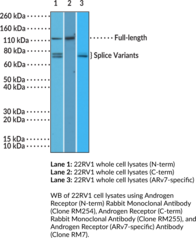
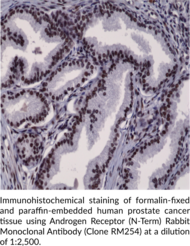
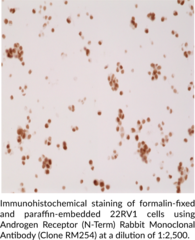
Androgen receptor is a ligand-activated transcription factor and member of the steroid hormone receptor family.1,2 It is composed of an N-terminal regulatory domain (AF-1 site), a DNA-binding domain that contains two zinc fingers, a hinge region containing a nuclear localization signal, and a C-terminal ligand-binding domain (AF-2 site). Unligated androgen receptors are localized to the cytoplasm and bound to heat shock protein 23 (Hsp23), -56, -70, and -90 in a stable conformation that facilitates androgen binding. Androgen binding induces dissociation of the Hsps and nuclear translocation of the androgen receptor where it binds to androgen response elements (AREs) and induces gene transcription. Mutations in AR, the gene encoding the androgen receptor, induce abnormalities in male development ranging from partial androgen insensitivity to complete male-to-female phenotypic sex reversal.2 Androgen receptor knockdown induces bone loss, complete loss of sexual behaviors, and reduced aggressive behaviors in male mice, as well as defective folliculogenesis and reduced fertility in female mice. Expression of C-terminally truncated and constitutively active androgen receptor mutants are associated with reduced progression-free survival, lower prostate-specific androgen (PSA) response rates, and shorter median overall survival in patients with castration-resistant prostate cancer.3 Cayman’s Androgen Receptor (N-Term) Rabbit Monoclonal Antibody (Clone RM254) can be used for immunohistochemistry (IHC) and Western blot (WB) applications. The antibody recognizes the N-terminus to detect the full-length androgen receptor and its splice variants from human samples.
WARNING This product is not for human or veterinary use.
References & Product Citations
1. Drug insight: Role of the androgen receptor in the development and progression of prostate cancer. Nat. Clin. Pract. Oncol. 4(4), 236-244 (2007).
2. The androgen receptor in health and disease. Annu. Rev. Physiol. 75, 201-224 (2013).
3. Targeting the androgen receptor in metastatic castrate-
Contact Info
Cayman Chemical1180 East Ellsworth RoadAnn Arbor, Michigan 48108 USAToll Free: (800) 364-9897(USA and Canada only)Fax: (734) 971-3640


