
Technical Support & Resources
Visit our FAQ
Contact Us
Toll Free Phone (USA and Canada Only): (888) 526-5351
Direct Phone: (734) 975-3888
Product Categories
Technical Information
- SYP
- Major Synaptic Vesicle Protein p38
Shipping & Storage Information
Recommended Products
Certificates of Analysis & Batch Specific Data
Provide batch numbers separated by commas to download or request available product inserts, QC sheets, certificates of analysis, data packs, and GC-MS data.

Visit Our Cancer Resource Center
Find Tools & Resources to Study the Hallmarks of Cancer
- Cancer cell signaling & regulation
- Cancer metabolism
- Tumor microenvironment
Product Description
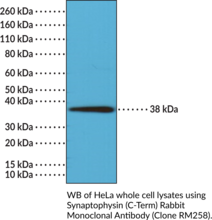
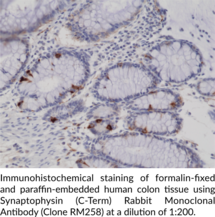
Synaptophysin is a transmembrane glycoprotein found in synaptic vesicle membranes of the CNS, neuroendocrine tissues, and certain tumors.1,2 It is comprised of a cytoplasmic N-terminus, four transmembrane domains with the two intravesicular loops containing one disulfide bond per loop, and a cytoplasmic C-terminus containing ten pentapeptide repeat domains.1 Nine of the repeat domains begin with a tyrosine residue subject to phosphorylation.3 Synaptophysin interacts with the v-SNARE synaptobrevin and the GTPase dynamin to facilitate exo-endocytosis coupling in the release of neurotransmitters.3,4,5 Mutations in SYP, the gene encoding synaptophysin, are associated with X-linked intellectual disability.6 Synaptophysin has commonly been used as a marker of synapses and synapse vesicles in the brain.1 Cayman’s Synaptophysin (C-Term) Rabbit Monoclonal Antibody (Clone RM258) can be used for immunohistochemistry (IHC) and Western blot (WB) applications. The antibody recognizes synaptophysin at approximately 38 kDa from human samples.
WARNING This product is not for human or veterinary use.
References & Product Citations
1. Synaptophysin: leading actor or walk-
2. Synaptophysin: a marker protein for neuroendocrine cells and neoplasms. Proc. Natl. Acad. Sci. USA 83(10), 3500-3504 (1986).
3. Tyrosine phosphorylation of synaptophysin in synaptic vesicle recycling. Biochem. Soc. Trans. 33(Pt 6), 1350-1353 (2005).
4. Synaptophysin regulates the kinetics of synaptic vesicle endocytosis in central neurons. Neuron 70(5), 847-854 (2011).
5. Molecular mechanisms for the coupling of endocytosis to exocytosis in neurons. Front. Mol. Neurosci. 10, 47 (2017).
6. A systematic, large-
Contact Info
Cayman Chemical1180 East Ellsworth RoadAnn Arbor, Michigan 48108 USAToll Free: (800) 364-9897(USA and Canada only)Fax: (734) 971-3640


