
Technical Support & Resources
Visit our FAQ
Contact Us
Toll Free Phone (USA and Canada Only): (888) 526-5351
Direct Phone: (734) 975-3888
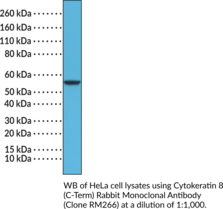
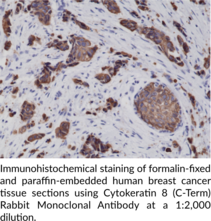
Technical Information
- Keratin, Type II Cytoskeletal 8
- CK-8
- Keratin-8
- KRT8
Shipping & Storage Information
Recommended Products
Certificates of Analysis & Batch Specific Data
Provide batch numbers separated by commas to download or request available product inserts, QC sheets, certificates of analysis, data packs, and GC-MS data.

Visit Our Cancer Resource Center
Find Tools & Resources to Study the Hallmarks of Cancer
- Cancer cell signaling & regulation
- Cancer metabolism
- Tumor microenvironment
Product Description
Cytokeratin 8 is a type II epithelial intermediate filament protein.1 It is composed of a central rod containing four α-helical domains, which are important for self-assembly, and non-helical head and tail domains at the N- and C-termini, respectively. Cytokeratin 8 is expressed in single-layered epithelial cells and epithelial-derived tumor cells.2 It dimerizes with the type I epithelial intermediate filament protein cytokeratin 18 to form a network of filament bundles throughout the cytoplasm.3 The tail of cytokeratin 8 binds to plasminogen and mediates invasiveness of cancer cells in vitro.4 A null mutation in KRT8, the gene encoding cytokeratin 8, is embryonic lethal in C57BL/6 x 129Sv, but not FVB/N, mice, which develop colorectal hyperplasia.5 Substitution mutations in KRT8, corresponding to residues in the head domain of the protein, disrupt filament reorganization following oxidative and non-oxidative stress in vitro and are associated with cryptogenic liver disease.2 Intratumoral levels of cytokeratin 8 and -18 are correlated with poor prognosis in patients with squamous cell carcinomas of the oral cavity.6 Cayman’s Cytokeratin 8 (C-Term) Rabbit Monoclonal Antibody (Clone RM266) can be used for immunohistochemistry (IHC) and Western blot (WB) applications.
WARNING This product is not for human or veterinary use.
References & Product Citations
1. Keratin function in skin epithelia: A broadening palette with surprising shades. Curr. Opin. Cell Biol. 19(1), 13-23 (2007).
2. Keratin 8 mutations in patients with cryptogenic liver disease. N. Engl. J. Med. 344(21), 1580-1587 (2001).
3. Cytokeratin 8 functions as a major plasminogen receptor in select epithelial and carcinoma cells. Front Biosci. 6, 1403-1411 (2001).
4. Cytokeratin 8 ectoplasmic domain binds urokinase-
5. Colorectal hyperplasia and inflammation in keratin 8-
6. Cytokeratin 8/18 expression indicates a poor prognosis in squamous cell carcinomas of the oral cavity. BMC Cancer 6, 10 (2006).
Contact Info
Cayman Chemical1180 East Ellsworth RoadAnn Arbor, Michigan 48108 USAToll Free: (800) 364-9897(USA and Canada only)Fax: (734) 971-3640


