
Technical Support & Resources
Visit our FAQ
Contact Us
Toll Free Phone (USA and Canada Only): (888) 526-5351
Direct Phone: (734) 975-3888
Product Categories
Technical Information
- JAM-1
- F11R
- JCAM
- KAT
- PAM-1
- CD321
- Platelet Adhesion Molecule 1
Shipping & Storage Information
Recommended Products
Certificates of Analysis & Batch Specific Data
Provide batch numbers separated by commas to download or request available product inserts, QC sheets, certificates of analysis, data packs, and GC-MS data.

Visit Our Cancer Resource Center
Find Tools & Resources to Study the Hallmarks of Cancer
- Cancer cell signaling & regulation
- Cancer metabolism
- Tumor microenvironment
Product Description
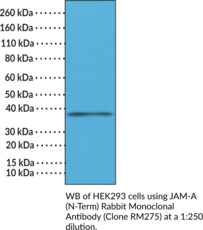
Junctional adhesion molecule A (JAM-A), known previously as JAM-1, is a type I transmembrane protein and member of the immunoglobulin (Ig) superfamily that regulates epithelial and endothelial barrier and tight junction formation.1,2,3 It is comprised of an N-terminal extracellular domain containing two Ig-like domains that mediate cell-cell interactions, a single transmembrane domain, and a cytoplasmic tail containing a PDZ binding motif that interacts with numerous cytoplasmic scaffold proteins and intracellular signaling molecules.1,2 JAM-A exists as a monomer or homodimer, is primarily expressed by epithelial cells, endothelial cells, and leukocytes, and localizes to the cell surface.1 It associates via cis- or trans-interactions with a variety of cell surface proteins, including the additional JAM family members JAM-B and JAM-C, which are also expressed by epithelial cells, endothelial cells, and leukocytes, as well as integrins expressed by leukocytes, such as αLβ2, αMβ2, and α4β1, to mediate homotypic or heterotypic cell-cell adhesions that regulate tight junction assembly and transepithelial cell migration. JAM-A has additional roles in angiogenesis, hemostasis, cell cycle, and inflammation. JAM-A levels are increased in plasma cells isolated from patients with multiple myeloma and are associated with poor prognosis.4 Cayman's JAM-A (N-Term) Rabbit Monoclonal Antibody (Clone RM275) can be used for immunohistochemistry (IHC) and Western blot (WB) applications.
WARNING This product is not for human or veterinary use.
References & Product Citations
1. Junctional adhesion molecules (JAMs): Cell adhesion receptors with pleiotropic functions in cell physiology and development. Physiol. Rev. 97(4), 1529-1554 (2017).
2. Junctional adhesion molecule 1 regulates epithelial cell morphology through effects on β1 integrins and Rap1 activity. The Journal of Biological Chemisty 280(12), 11665-11674 (2005).
3. Involvement of the junctional adhesion molecule-
4. JAM-
Contact Info
Cayman Chemical1180 East Ellsworth RoadAnn Arbor, Michigan 48108 USAToll Free: (800) 364-9897(USA and Canada only)Fax: (734) 971-3640


