
Technical Support & Resources
Visit our FAQ
Contact Us
Toll Free Phone (USA and Canada Only): (888) 526-5351
Direct Phone: (734) 975-3888

Technical Information
- ACTN4
- Focal Segmental Glomerulosclerosis 1
- FSGS1
Shipping & Storage Information
Recommended Products
Certificates of Analysis & Batch Specific Data
Provide batch numbers separated by commas to download or request available product inserts, QC sheets, certificates of analysis, data packs, and GC-MS data.

Visit Our Cancer Resource Center
Find Tools & Resources to Study the Hallmarks of Cancer
- Cancer cell signaling & regulation
- Cancer metabolism
- Tumor microenvironment
Product Description
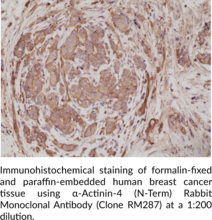
α-Actinin-4 (ACTN4) is a filamentous actin-crosslinking protein and member of the α-actinin protein family with roles in the regulation of cytoskeletal integrity and cell movement, as well as gene transcription.1,2 It is composed of an N-terminal actin-binding region with two calponin-homology repeats, a rod domain containing four spectrin-like repeats that is essential for anti-parallel dimerization, and a C-terminal calmodulin-like domain.1 ACTN4 is ubiquitously expressed in non-muscle cells and primarily localized to the cytoplasm where it participates in cytoskeletal organization.2 However, ACTN4 can be translocated to the nucleus and induce transcription via interaction with nuclear receptors, including estrogen receptor α, retinoic acid receptors (RARs), and the vitamin D receptor, and acts as a transcriptional co-activator of NF-κB. Mutation of ACTN4 induces podocyte injury caused by cytoskeletal dysregulation and proteotoxicity and has been seen in patients with hereditary focal segmental glomerulosclerosis.3 ACTN4 is overexpressed and associated with tumor metastasis in various cancers.2 Cayman's α-Actinin-4 (N-Term) Rabbit Monoclonal Antibody (Clone RM287) can be used for immunohistochemistry (IHC) and Western blot (WB) applications.
WARNING This product is not for human or veterinary use.
References & Product Citations
1. ACTN4 regulates the stability of RIPK1 in melanoma. Oncogene 37(29), 4033-4045 (2018).
2. α-
3. Proteostasis as a therapeutic target in glomerular injury associated with mutant α-
Contact Info
Cayman Chemical1180 East Ellsworth RoadAnn Arbor, Michigan 48108 USAToll Free: (800) 364-9897(USA and Canada only)Fax: (734) 971-3640


