
Technical Support & Resources
Visit our FAQ
Contact Us
Toll Free Phone (USA and Canada Only): (888) 526-5351
Direct Phone: (734) 975-3888
Product Categories
Research Area

Technical Information
Shipping & Storage Information
Recommended Products
Certificates of Analysis & Batch Specific Data
Provide batch numbers separated by commas to download or request available product inserts, QC sheets, certificates of analysis, data packs, and GC-MS data.
Product Description
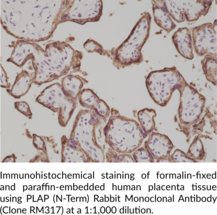
Placental alkaline phosphatase (PLAP) is the placenta-specific isoenzyme of AP encoded by the ALPP gene in humans.1,2 It exists as a homodimer where each monomer is composed of an N-terminal α-helix and a crown domain that stabilize PLAP homodimers, a Zn2+- and Mg2+-containing active site with a catalytic serine residue, and a non-catalytic metal-binding site occupied by Ca2+.3,4 PLAP is predominately expressed by syncytiotrophoblasts in the placenta and is tethered to the plasma membrane by a glycosylphosphatidylinositol (GPI) anchor.4,3 It is also present at low levels in the cervix, ovaries, and type I pneumocytes, as well as in the serum.1,3 Increased PLAP activity has been found in tumor tissue and cerebrospinal fluid (CSF) isolated from patients with intracranial germ cell tumors.5 Cayman's PLAP (N-Term) Rabbit Monoclonal Antibody (Clone RM317) can be used for immunohistochemistry (IHC) and Western blot (WB) applications.
WARNING This product is not for human or veterinary use.
References & Product Citations
1. Recent advances with alkaline phosphatase isoenzymes and their inhibitors. Arch. Pharm. (Weinheim) 353(5), e2000011 (2020).
2. Structure, genomic DNA typing, and kinetic characterization of the D allozyme of placental alkaline phosphatase (PLAP/ALPP). Hum. Mutat. 19(3), 258-267 (2002).
3. Alkaline phosphatases : Structure, substrate specificity and functional relatedness to other members of a large superfamily of enzymes. Purinergic Signal. 2(2), 335-341 (2006).
4. Crystal structure of alkaline phosphatase from human placenta at 1.8 Å resolution. Implication for a substrate specificity. The Journal of Biological Chemisty 276(12), 9158-9165 (2001).
5. Placental alkaline phosphatase levels in cerebrospinal fluid can have a decisive role in the differential diagnosis of intracranial germ cell tumors. J. Neurosurg. 131(3), 687-694 (2018).
Contact Info
Cayman Chemical1180 East Ellsworth RoadAnn Arbor, Michigan 48108 USAToll Free: (800) 364-9897(USA and Canada only)Fax: (734) 971-3640


