
Technical Support & Resources
Visit our FAQ
Contact Us
Toll Free Phone (USA and Canada Only): (888) 526-5351
Direct Phone: (734) 975-3888
Product Categories
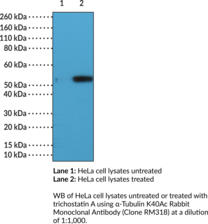
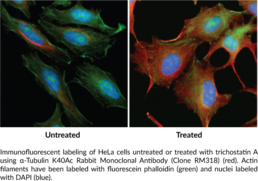
Technical Information
Shipping & Storage Information
Recommended Products
Certificates of Analysis & Batch Specific Data
Provide batch numbers separated by commas to download or request available product inserts, QC sheets, certificates of analysis, data packs, and GC-MS data.

Visit Our Cancer Resource Center
Find Tools & Resources to Study the Hallmarks of Cancer
- Cancer cell signaling & regulation
- Cancer metabolism
- Tumor microenvironment
Product Description
α-Tubulin is a cytoskeletal protein and constituent of microtubules, a cytoskeletal assembly that has roles in a variety of cellular processes, including cell motility, division, differentiation, and intracellular transport.1 α-Tubulin is highly conserved in eukaryotes and expressed in a cell- and isotype-specific manner.2 There are eight human α-tubulin isotypes that consist of an N-terminal domain, which binds GTP and is required for microtubule self-assembly, and a variable C-terminal tail, which contains interaction sites for microtubule-associated proteins (MAPs) and is subject to a variety of post-translational modifications that regulate microtubule function and stability.3,4,1,5 α-Tubulin can be acetylated at a variety of sites, including on the luminal side of microtubules at lysine 40 (K40Ac), by α-tubulin N-acetyltransferase 1 (α-TAT) and deacetylated primarily by histone deacetylase 6 (HDAC6).6,7 α-Tubulin K40Ac is a marker of stable microtubules that recruits dynein and kinesin-1 to microtubules. It is also involved in regulating microtubule architecture as well as immune and viral responses.6,8,7 The levels of α-tubulin acetylation are decreased in a variety of neurological disorders, increased in various cancers, and dysregulated in immune disorders.7 Cayman’s α-Tubulin K40Ac Rabbit Monoclonal Antibody (Clone RM318) can be used for immunocytochemistry (ICC) and Western blot (WB) applications.
WARNING This product is not for human or veterinary use.
References & Product Citations
1. The tubulin code at a glance. J. Cell Sci. 130(8), 1347-1353 (2017).
2. Tubulin: Structure, functions and roles in disease. Cells 8(10), 1294 (2019).
3. Tubulin isoform composition tunes microtubule dynamics. Mol. Biol. Cell 28(25), 3564-3572 (2017).
4. New insights into microtubule elongation mechanisms. Commun. Integr. Biol. 4(1), 10-13 (2011).
5. Posttranslational modifications of α-
6. The growing landscape of tubulin acetylation: Lysine 40 and many more. Biochem. J. 473(13), 1859-1868 (2016).
7. Tubulin acetylation: Responsible enzymes, biological functions and human diseases. Cell. Mol. Life Sci. 72(22), 4237-4255 (2015).
8. Histone deacetylase 6 inhibition compensates for the transport deficit in Huntington’s disease by increasing tubulin acetylation. J. Neurosci. 27(13), 3571-3583 (2007).
Contact Info
Cayman Chemical1180 East Ellsworth RoadAnn Arbor, Michigan 48108 USAToll Free: (800) 364-9897(USA and Canada only)Fax: (734) 971-3640


