
Technical Support & Resources
Visit our FAQ
Contact Us
Toll Free Phone (USA and Canada Only): (888) 526-5351
Direct Phone: (734) 975-3888
Product Categories
Technical Information
- CK-14
- Keratin-14
- Keratin, Type II Cytoskeletal 14
- KRT14
Shipping & Storage Information
Recommended Products
Certificates of Analysis & Batch Specific Data
Provide batch numbers separated by commas to download or request available product inserts, QC sheets, certificates of analysis, data packs, and GC-MS data.

Visit Our Cancer Resource Center
Find Tools & Resources to Study the Hallmarks of Cancer
- Cancer cell signaling & regulation
- Cancer metabolism
- Tumor microenvironment
Product Description
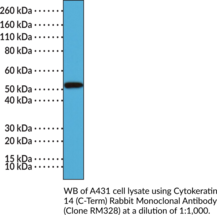
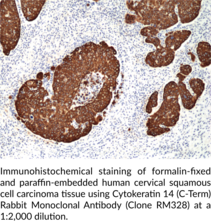
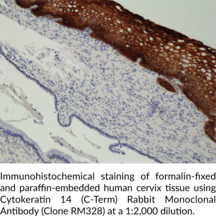
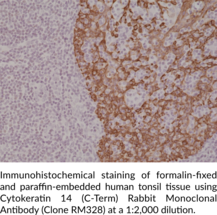
Cytokeratin 14 (CK-14) is a type I acidic epithelial intermediate filament protein.1 It is composed of a central rod containing four α-helical domains, which are important for self-assembly, and non-helical head and tail domains at the N- and C-termini, respectively.2,3 CK-14 is expressed in stratified squamous epithelial cells, keratinocytes, and myoepithelial cells in the basal layer of the epidermis and is an integral component of the epithelial cell cytoskeleton.1,4,5 It dimerizes with the type II basic epithelial intermediate filament protein CK-5 via heptad repeats in the central rod domain to form a network of filament bundles throughout the cytoplasm.2,3 Increased tumor levels of CK-14 have been found in patients with squamous cell carcinomas of the bladder, lung, or cervix.6 Mutations in the gene encoding CK-14 have been found in patients with epidermolysis bullosa simplex (EBS), a disorder characterized by skin blistering.7 Cayman's Cytokeratin 14 (C-Term) Rabbit Monoclonal Antibody (Clone RM328) can be used for immunohistochemistry (IHC) and Western blot (WB) applications.
WARNING This product is not for human or veterinary use.
References & Product Citations
1. Cytokeratin 14 is expressed in immature cells in rat taste buds. J. Mol. Histol. 39(2), 193-199 (2008).
2. The nonhelical tail domain of keratin 14 promotes filament bundling and enhances the mechanical properties of keratin intermediate filaments in vitro. J. Cell. Biol. 155(5), 747-754 (2001).
3. Structural basis for heteromeric assembly and perinuclear organization of keratin filaments. Nat. Struct. Mol. Biol. 19(7), 707-715 (2012).
4. Regulation of keratin expression by retinoids. Dermatoendocrinol. 3(3), 136-140 (2011).
5. Distribution of p63, cytokeratins 5/6 and cytokeratin 14 in 51 normal and 400 neoplastic human tissue samples using TARP-
6. Cytokeratin 14 expression in epithelial neoplasms: A survey of 435 cases with emphasis on its value in differentiating squamous cell carcinomas from other epithelial tumours. Histopathology 39(1), 9-16 (2001).
7. Development of allele-
Contact Info
Cayman Chemical1180 East Ellsworth RoadAnn Arbor, Michigan 48108 USAToll Free: (800) 364-9897(USA and Canada only)Fax: (734) 971-3640


