
Technical Support & Resources
Visit our FAQ
Contact Us
Toll Free Phone (USA and Canada Only): (888) 526-5351
Direct Phone: (734) 975-3888
Product Categories
Technical Information
- e-GST
- Glutathione-S-Transferase Pi-1
- GST3
- GST-Pi
- GSTP1-1
Shipping & Storage Information
Recommended Products
Certificates of Analysis & Batch Specific Data
Provide batch numbers separated by commas to download or request available product inserts, QC sheets, certificates of analysis, data packs, and GC-MS data.
Product Description
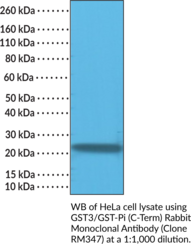
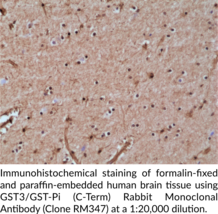
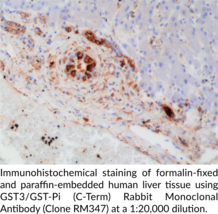
Glutathione S-transferase 3 (GST3), also known as GST-Pi, is an enzyme that catalyzes the conjugation of glutathione (GSH) to the electrophilic center of various phase I toxic xenobiotic metabolites, facilitating their excretion by phase III membrane channels, transporters, and pumps.1 It functions as a homodimer, with each monomer containing an N-terminal GSH-binding domain and a C-terminal domain with a hydrophobic cavity (H-site) for toxic compound binding. GST3 is expressed primarily in erythrocytes, as well as in the brain, heart, lung, testis, skin, kidney, pancreas, and saliva. GST3 dimers can bind a nitric oxide (NO) carrier, such as S-nitrosoglutathione or dinitrosyl-diglutathionyl-iron complex (DNDGIC), with one active site, indicating a role in the storage and transport of NO, while maintaining detoxification activity in the second active site.2 Expression of GSTP1, the gene encoding GST3, is increased in patients with advanced-stage chronic kidney disease. GSTP1 polymorphisms are associated with increased risk of Parkinson's disease following exposure to cigarette smoke or pesticides, as well as with amyotrophic lateral sclerosis. Cayman's GST3/GST-Pi (C-Term) Rabbit Monoclonal Antibody (Clone RM347) can be used for immunohistochemistry (IHC) and Western blot (WB) applications.
WARNING This product is not for human or veterinary use.
References & Product Citations
1. Glutathione Transferase P1-
2. Human glutathione transferase P1-
Contact Info
Cayman Chemical1180 East Ellsworth RoadAnn Arbor, Michigan 48108 USAToll Free: (800) 364-9897(USA and Canada only)Fax: (734) 971-3640


