
Technical Support & Resources
Visit our FAQ
Contact Us
Toll Free Phone (USA and Canada Only): (888) 526-5351
Direct Phone: (734) 975-3888
Product Categories

Technical Information
- Spastic Paraplegia 4
- SPG4
Shipping & Storage Information
Recommended Products
Certificates of Analysis & Batch Specific Data
Provide batch numbers separated by commas to download or request available product inserts, QC sheets, certificates of analysis, data packs, and GC-MS data.
Product Description
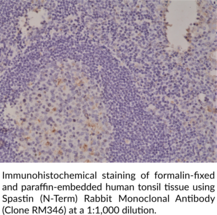
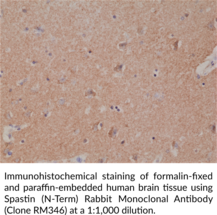
Spastin is an ATP-dependent microtubule-severing protein and a member of the ATPases associated with various cellular activities (AAA) family encoded by SPG4 in humans.1 It is composed of a hydrophobic region, microtubule-interacting and endosomal trafficking (MIT) domain, microtubule-binding domain, and an AAA ATPase domain.2,3 It is ubiquitously expressed and localized to the endoplasmic reticulum. Alternative splicing of SPG4 produces a second shorter isoform that lacks the first 87 amino acids of full-length spastin and is localized to the cytosol.4 Spastin functions as a hexamer that binds to tubulin dimers on the plus-end of microtubules and disrupts tubulin dimer interactions in an ATP-dependent manner to sever them from microtubules.5 Mutations in SPG4 are associated with autosomal dominant uncomplicated hereditary spastic paraplegia (HSP).2,4 Cayman’s Spastin (N-Term) Rabbit Monoclonal Antibody (Clone RM346) can be used for immunohistochemistry (IHC) and Western blot (WB) applications.
WARNING This product is not for human or veterinary use.
References & Product Citations
1. Spastin depletion increases tubulin polyglutamylation and impairs kinesin-
2. Spastin MIT domain disease-
3. Spastin, the protein mutated in autosomal dominant hereditary spastic paraplegia, is involved in microtubule dynamics. Hum. Mol. Genet. 11(2), 153-163 (2002).
4. Functional differences of short and long isoforms of spastin harboring missense mutation. Dis. Model Mech. 11(9), dmm033704 (2018).
5. Microtubule-
Contact Info
Cayman Chemical1180 East Ellsworth RoadAnn Arbor, Michigan 48108 USAToll Free: (800) 364-9897(USA and Canada only)Fax: (734) 971-3640


