
Technical Support & Resources
Visit our FAQ
Contact Us
Toll Free Phone (USA and Canada Only): (888) 526-5351
Direct Phone: (734) 975-3888
Product Categories
Technical Information
- Leukemia-associated Phosphoprotein p18
- Metablastin
- Oncoprotein 18
- Op18
- STMN1
Shipping & Storage Information
Recommended Products
Certificates of Analysis & Batch Specific Data
Provide batch numbers separated by commas to download or request available product inserts, QC sheets, certificates of analysis, data packs, and GC-MS data.

Visit Our Cancer Resource Center
Find Tools & Resources to Study the Hallmarks of Cancer
- Cancer cell signaling & regulation
- Cancer metabolism
- Tumor microenvironment
Product Description
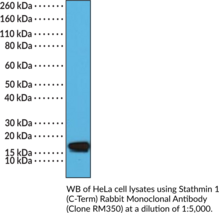
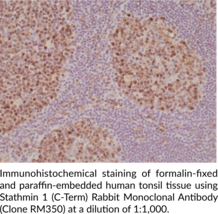
Stathmin 1 is a microtubule-destabilizing phosphoprotein and the founding member of the stathmin family of proteins.1,2 It is composed of a stathmin-like domain (SLD) that contains an N-terminal domain, a proline-rich domain, and two tubulin-binding repeats, which each bind one tubulin αβ heterodimer.2 Stathmin 1 also contains several phosphorylation sites which, when phosphorylated, negatively regulate its interaction with tubulin. It is ubiquitously expressed, with high levels in the nervous system, and localizes to the cytoplasm. Stathmin 1 binds to tubulin in a phosphorylation-dependent manner and regulates microtubule dynamics by promoting destabilization or preventing polymerization.2,3 Stathmin 1 is inactivated prior to mitosis and reactivated by dephosphorylation near the end of mitosis.3 STMN1, the gene encoding stathmin, is overexpressed in a variety of cancers and is associated with metastasis and poor prognosis.1,4 Cayman’s Stathmin (C-Term) Rabbit Monoclonal Antibody (Clone RM350) can be used for immunohistochemistry (IHC) and Western blot (WB) applications.
WARNING This product is not for human or veterinary use.
References & Product Citations
1. Stathmin: A protein with many tasks. New biomarker and potential target in cancer. Expert Opin. Ther. Targets 15(11), 1249-1266 (2011).
2. Neuronal stathmins: A family of phosphoproteins cooperating for neuronal development, plasticity and regeneration. Prog. Neurobiol. 126, 1-18 (2015).
3. The role of stathmin in the regulation of the cell cycle. J. Cell. Biochem. 93(2), 242-250 (2004).
4. Overexpression of stathmin promotes metastasis and growth of malignant solid tumors: A systemic review and meta-
Contact Info
Cayman Chemical1180 East Ellsworth RoadAnn Arbor, Michigan 48108 USAToll Free: (800) 364-9897(USA and Canada only)Fax: (734) 971-3640


