
Technical Support & Resources
Visit our FAQ
Contact Us
Toll Free Phone (USA and Canada Only): (888) 526-5351
Direct Phone: (734) 975-3888
Product Categories

Technical Information
- CK-4
- Keratin-4
- Keratin, Type II Cytoskeletal 4
- KRT4
Shipping & Storage Information
Recommended Products
Certificates of Analysis & Batch Specific Data
Provide batch numbers separated by commas to download or request available product inserts, QC sheets, certificates of analysis, data packs, and GC-MS data.
Product Description
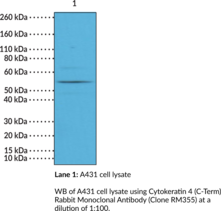
Cytokeratin 4 is a type II epithelial intermediate filament protein.1 It is composed of a central rod containing four α-helical domains, which are important for self-assembly, and non-helical head and tail domains at the N- and C-termini, respectively. Cytokeratin 4 is expressed in mucosal stratified squamous epithelial cells, columnar luminal cells of the respiratory epithelium, and in non-stratified simple epithelial cells, with the highest expression in the esophagus and cornea.2 Cytokeratin 4 dimerizes with the type I epithelial intermediate filament protein cytokeratin 13, with the dimers then combining to form tetramers.1,2 Mice lacking Krt4, the gene encoding cytokeratin 4, have disruptions in the epithelial integrity of the esophagus, tongue, and cornea, including basal hyperplasia, lack of cell maturation, and hyperkeratosis.3 Mutations in KRT4 have been associated with white sponge nevus, a disorder characterized by thickened white, spongy plaques on the oral mucosa.2 Cayman’s Cytokeratin 4 (C-Term) Rabbit Monoclonal Antibody (Clone RM355) can be used for immunohistochemistry (IHC) and Western blot applications.
WARNING This product is not for human or veterinary use.
References & Product Citations
1. Keratin function in skin epithelia: A broadening palette with surprising shades. Curr. Opin. Cell Biol. 19(1), 13-23 (2007).
2. The human keratins: biology and pathology. Histochem. Cell Biol. 129(6), 705-733 (2008).
3. Mouse keratin 4 is necessary for internal epithelial integrity. The Journal of Biological Chemisty 273(37), 23904-23911 (1998).
Contact Info
Cayman Chemical1180 East Ellsworth RoadAnn Arbor, Michigan 48108 USAToll Free: (800) 364-9897(USA and Canada only)Fax: (734) 971-3640


