
Technical Support & Resources
Visit our FAQ
Contact Us
Toll Free Phone (USA and Canada Only): (888) 526-5351
Direct Phone: (734) 975-3888
Product Categories
Technical Information
- Special AT-rich Sequence-Binding Protein 2
Shipping & Storage Information
Recommended Products
Certificates of Analysis & Batch Specific Data
Provide batch numbers separated by commas to download or request available product inserts, QC sheets, certificates of analysis, data packs, and GC-MS data.

Visit Our Cancer Resource Center
Find Tools & Resources to Study the Hallmarks of Cancer
- Cancer cell signaling & regulation
- Cancer metabolism
- Tumor microenvironment
Product Description
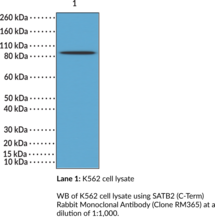
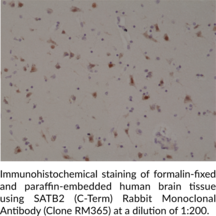
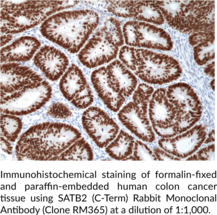
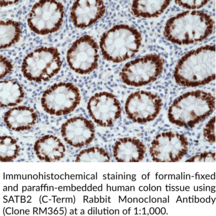
Special AT-rich sequence-binding protein 2 (SATB2) is a transcription factor.1 It is composed of two CUT domains and a homeobox domain, which bind DNA matrix attachment regions (MARs) and promote chromatin remodeling.1,2 SATB2 is expressed in superficial cortical layers during embryonic development, where it regulates the formation of callosal projection neurons by repressing Ctip2 expression, and by hippocampal and cortical pyramidal neurons in the adult brain, where it has roles in synaptic plasticity and neurotransmission.3,2 It has additional functions in B cell and osteoblast differentiation.2 SATB2 has been used as a marker for primary or metastatic colorectal cancer.4 SATB2 variants have been found in patients with SATB2-associated syndrome, an autosomal dominant disorder characterized by intellectual disability and craniofacial abnormalities, as well as in patients with schizophrenia.1,5 Cayman's SATB2 (C-Term) Rabbit Monoclonal Antibody (Clone RM365) can be used for immunohistochemistry (IHC) and Western blot (WB) applications.
WARNING This product is not for human or veterinary use.
References & Product Citations
1. Mutation update for the SATB2 gene. Hum. Mutat. 40(8), 1013-1029 (2019).
2. Satb2 regulates callosal projection neuron identity in the developing cerebral cortex. Neuron 57(3), 364-377 (2008).
3. Genes encoding SATB2-
4. SATB2 is a promising biomarker for identifying a colorectal origin for liver metastatic adenocarcinomas. EBioMedicine 28, 62-69 (2018).
5. Common variants in SATB2 are associated with schizophrenia in Uygur Chinese population. Psychiatr. Genet. 29(4), 120-126 (2018).
Contact Info
Cayman Chemical1180 East Ellsworth RoadAnn Arbor, Michigan 48108 USAToll Free: (800) 364-9897(USA and Canada only)Fax: (734) 971-3640


