
Technical Support & Resources
Visit our FAQ
Contact Us
Toll Free Phone (USA and Canada Only): (888) 526-5351
Direct Phone: (734) 975-3888
Product Categories

Technical Information
- Hemolysin Co-regulated Protein 1
- HPC-1
- Stx-1A
Shipping & Storage Information
Recommended Products
Certificates of Analysis & Batch Specific Data
Provide batch numbers separated by commas to download or request available product inserts, QC sheets, certificates of analysis, data packs, and GC-MS data.
Product Description
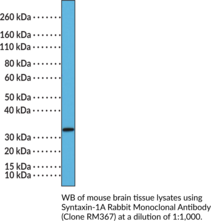
Syntaxin-1A is a type II integral membrane protein and member of the SNARE complex that has a major role in neuronal exocytosis.1,2 It is composed of a cytoplasmic N-terminal regulatory domain, a coiled-coil SNARE domain that mediates protein-protein interactions, and a C-terminal transmembrane tail that is required for membrane localization.3,4 Syntaxin-1A is located primarily on neuronal plasma membranes and associates with synaptosomal-associated protein 25 (SNAP-25), vesicle-associated membrane protein (VAMP), and the syntaxin-binding protein Munc18 to form the SNARE complex, which facilitates synaptic vesicle docking and neurotransmitter release in a calcium-dependent manner.1,5 It is also found in pancreatic β cells, where it is involved in insulin secretion, as well as in the heart.6,7 STX1A SNPs have been found in patients with Asperger syndrome, attention-deficit hyperactivity disorder (ADHD), or coronary artery disease.7,8,9 Cayman's Syntaxin-1A Rabbit Monoclonal Antibody (Clone RM367) can be used for immunohistochemistry (IHC) and Western blot (WB) applications.
WARNING This product is not for human or veterinary use.
References & Product Citations
1. Neuronal SNARE complex: A protein folding system with intricate protein-
2. Structural analysis of the neuronal SNARE protein syntaxin-
3. Springs and zippers: Coiled coils in SNARE-
4. The syntaxins. Genome Biol. 2(11), 3012.3011-3012.3017 (2001).
5. Calcium control of neurotransmitter release. Cold Spring Harb. Perspect. Biol. 4(1), a011353 (2012).
6. New roles of syntaxin-
7. The Syntaxin-
8. STX1A and Asperger syndrome: A replication study. Mol. Autism 5(1), 14 (2014).
9. STX1A gene variations contribute to the susceptibility of children attention-
Contact Info
Cayman Chemical1180 East Ellsworth RoadAnn Arbor, Michigan 48108 USAToll Free: (800) 364-9897(USA and Canada only)Fax: (734) 971-3640


