
Technical Support & Resources
Visit our FAQ
Contact Us
Toll Free Phone (USA and Canada Only): (888) 526-5351
Direct Phone: (734) 975-3888
Product Categories
Technical Information
- CK-10
- Keratin-10
- Keratin, Type I Cytoskeletal 10
- KRT10
Shipping & Storage Information
Recommended Products
Certificates of Analysis & Batch Specific Data
Provide batch numbers separated by commas to download or request available product inserts, QC sheets, certificates of analysis, data packs, and GC-MS data.

Visit Our Cancer Resource Center
Find Tools & Resources to Study the Hallmarks of Cancer
- Cancer cell signaling & regulation
- Cancer metabolism
- Tumor microenvironment
Product Description
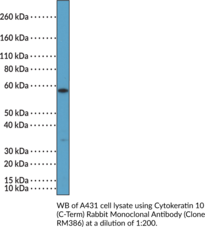
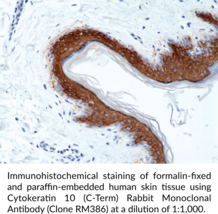
Cytokeratin 10 (CK-10) is a type I acidic epithelial intermediate filament protein.1 It is composed of a central rod containing four α-helical domains, which are important for self-assembly, and non-helical head and tail domains at the N- and C-termini, respectively.2 CK-10 expression is induced upon keratinocyte differentiation, increasing during keratinocyte migration from the basal layer to the suprabasal layer of the epidermis.1 It dimerizes with the type II epithelial intermediate filament protein CK-1 via heptad repeats in the central rod domain to form a network of filament bundles throughout the cytoplasm.3 Increased tumor CK10 expression has been found in patients with hepatocellular carcinoma (HCC) and is associated with poor prognosis.4 CK10 mutations have been found in patients with epidermolysis bullosa simplex (EBS), a disorder characterized by skin blistering.3 Cayman's Cytokeratin 10 (C-Term) Rabbit Monoclonal Antibody (Clone RM386) can be used for immunohistochemistry (IHC) and Western blot (WB) applications.
WARNING This product is not for human or veterinary use.
References & Product Citations
1. The human keratins: biology and pathology. Histochem. Cell Biol. 129(6), 705-733 (2008).
2. Keratin function in skin epithelia: A broadening palette with surprising shades. Curr. Opin. Cell Biol. 19(1), 13-23 (2007).
3. Mutations in the non-
4. Cytokeratin 10 and cytokeratin 19: Predictive markers for poor prognosis in hepatocellular carcinoma patients after curative resection. Clin. Cancer Res. 14(12), 3850-3859 (2008).
Contact Info
Cayman Chemical1180 East Ellsworth RoadAnn Arbor, Michigan 48108 USAToll Free: (800) 364-9897(USA and Canada only)Fax: (734) 971-3640


