Technical Support & Resources
Visit our FAQ
Contact Us
Toll Free Phone (USA and Canada Only): (888) 526-5351
Direct Phone: (734) 975-3888
Product Categories
Technical Information
- CAD1
- CALD1
Shipping & Storage Information
Recommended Products
Certificates of Analysis & Batch Specific Data
Provide batch numbers separated by commas to download or request available product inserts, QC sheets, certificates of analysis, data packs, and GC-MS data.

Visit Our Cancer Resource Center
Find Tools & Resources to Study the Hallmarks of Cancer
- Cancer cell signaling & regulation
- Cancer metabolism
- Tumor microenvironment
Product Description
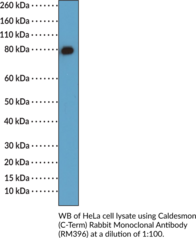
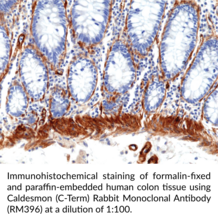
Caldesmon is an actin-binding protein that regulates actin cytoskeleton organization and assembly in smooth muscle and non-muscle cells.1,2 It is composed of an N-terminal myosin-binding domain, a central spacer region, and a C-terminal domain that contains binding sites for actin, as well as calmodulin and tropomyosin, and is subject to phosphorylation by a variety of kinases.1 Alternative splicing of the CALD1 pre-mRNA produces a heavy isoform, h-CaD, which is expressed by differentiated smooth muscle cells and localizes to actomyosin contractile structures, and a light isoform, l-CaD, which lacks the central spacer region and is expressed in non-muscle cells, where it localizes to podosomes and membrane ruffles.1,2 Caldesmon regulates the interaction between actin and myosin, influencing cell contractility and cytoskeletal remodeling in an isoform- and cell-dependent manner.2 It inhibits the activity of actomyosin ATPase, an effect that is enhanced by tropomyosin and reversed by Ca2+-calmodulin or phosphorylation. Increased caldesmon protein expression has been found in patients with metastatic oral squamous cell carcinoma (OSCC) and is associated with poor prognosis.3 Cayman's Caldesmon (C-Term) Rabbit Monoclonal Antibody (RM396) can be used for immunohistochemistry (IHC) and Western blot (WB) applications.
WARNING This product is not for human or veterinary use.
References & Product Citations
1. Caldesmon and the regulation of cytoskeletal functions. Adv. Exp. Med. Biol. 644, 250-272 (2008).
2. Roles of caldesmon in cell motility and actin cytoskeleton remodeling. International Review of Cell and Molecular Biology 274, 1-51 (2009).
3. Caldesmon expression in metastatic and non-
Contact Info
Cayman Chemical1180 East Ellsworth RoadAnn Arbor, Michigan 48108 USAToll Free: (800) 364-9897(USA and Canada only)Fax: (734) 971-3640