
Technical Support & Resources
Visit our FAQ
Contact Us
Toll Free Phone (USA and Canada Only): (888) 526-5351
Direct Phone: (734) 975-3888
Product Categories
Application
IDH1 R132H Rabbit Monoclonal Antibody (RM390)
Item No. 32326
Technical Information
- Isocitrate Dehydrogenase 1
Shipping & Storage Information
Recommended Products
Certificates of Analysis & Batch Specific Data
Provide batch numbers separated by commas to download or request available product inserts, QC sheets, certificates of analysis, data packs, and GC-MS data.

Visit Our Cancer Resource Center
Find Tools & Resources to Study the Hallmarks of Cancer
- Cancer cell signaling & regulation
- Cancer metabolism
- Tumor microenvironment
Product Description
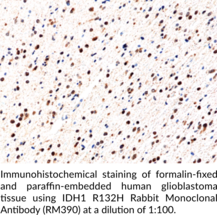
Isocitrate dehydrogenase 1 (IDH1) is a NADP+-dependent enzyme and a member of the IDH family.1 It is composed of a large domain, a small domain, and a clasp domain and exists as an asymmetric homodimer with active-site clefts formed by the large and small domains of one monomer and the small domain of the other. IDH1 is localized to the cytoplasm and catalyzes the oxidative decarboxylation of isocitrate to α-ketoglutarate (α-KG) using NADP+ as a cofactor.2 A mutant form of IDH1, where arginine is replaced by histidine at position 132 (IDH1R132H), changes the conformation of the IDH1R132H homodimer and IDH1R132/IDH1R132H heterodimer.3,4 The IDH1R132/IDH1R132H heterodimer is unable to achieve the closed conformation needed to produce α-KG and is enzymatically inactive. The IDH1R132H homodimer is not only enzymatically inactive for its native function but gains the ability to reduce α-KG to D-hydroxyglutarate (D-2-HG) using NADPH as a cofactor. Exogenous IDH1R132H is oncogenic in vitro and the expression of IDH1R132H in the mouse brain induces tumor nodules in a process resembling gliomagenesis.5,6 The IDH1R132H mutation has frequently been found in tumor tissue derived from patients with secondary glioblastomas but is associated with increased survival.5 Cayman’s IDH1 R132H Rabbit Monoclonal Antibody (RM390) can be used for immunohistochemistry (IHC) applications.
WARNING This product is not for human or veterinary use.
References & Product Citations
1. Structures of human cytosolic NADP-
2. IDH1 mutations in gliomas: When an enzyme loses its grip. Cancer Cell 17(1), 7-9 (2010).
3. Molecular mechanisms of "off-
4. IDH1 mutant structures reveal a mechanism of dominant inhibition. Cell Res. 20(12), 1279-1281 (2010).
5. Friend or foe—IDH1 mutations in glioma 10 years on. Carcinogenesis 40(11), 1299-1307 (2019).
6. Expression of Idh1R132H in the murine subventricular zone stem cell niche recapitulates features of early gliomagenesis. Cancer Cell 30(4), 578-594 (2016).
Contact Info
Cayman Chemical1180 East Ellsworth RoadAnn Arbor, Michigan 48108 USAToll Free: (800) 364-9897(USA and Canada only)Fax: (734) 971-3640


