
Technical Support & Resources
Visit our FAQ
Contact Us
Toll Free Phone (USA and Canada Only): (888) 526-5351
Direct Phone: (734) 975-3888
Product Categories

Technical Information
- CK-7
- Keratin-7
- Keratin, Type II Cytoskeletal 7
- KRT7
Shipping & Storage Information
Recommended Products
Certificates of Analysis & Batch Specific Data
Provide batch numbers separated by commas to download or request available product inserts, QC sheets, certificates of analysis, data packs, and GC-MS data.

Visit Our Cancer Resource Center
Find Tools & Resources to Study the Hallmarks of Cancer
- Cancer cell signaling & regulation
- Cancer metabolism
- Tumor microenvironment
Product Description
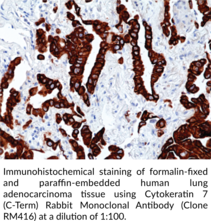
Cytokeratin 7 (CK-7) is an intermediate filament protein and a member of the cytokeratin protein family.1,2 It is a type II neutral-basic cytokeratin expressed in ductal, glandular, and transitional epithelial tissues, as well as endothelial cells, but not stratified squamous epithelia, and is localized to the cytoplasm.2,3 CK-7 is found in various tumors, including ductal, lobular, and mucinous carcinomas, as well as ovarian, but not colorectal, adenocarcinomas, malignant mesotheliomas, and transitional cell carcinomas.3 It is also found in chromophobe renal cell carcinomas but not oncocytoma and conventional carcinomas and has been used as a biomarker for differentiation of tumor origin.4 Hepatocyte expression of CK-7 is positively correlated with fibrosis stage in patients with hepatitis B and hepatitis C.5 Cayman’s Cytokeratin 7 (C-Term) Rabbit Monoclonal Antibody (Clone RM416) can be used for immunohistochemistry (IHC) and Western blot (WB) applications.
WARNING This product is not for human or veterinary use.
References & Product Citations
1. Biological functions of cytokeratin 18 in cancer. Mol. Cancer Res. 10(4), 485-493 (2012).
2. Immunohistology of the female genital tract. Diagnostic immunohistochemistry 690-762 (2010).
3. Application of cytokeratin 7 and 20 immunohistochemistry to diagnostic pathology. Curr. Diagn. Pathol. 7(2), 113-122 (2001).
4. Cytokeratin 7: A useful adjunct in the diagnosis of chromophobe renal cell carcinoma. Histopathology 40(6), 563-567 (2002).
5. Aberrant cytokeratin 7 expression of centrilobular hepatocytes: A clinicopathological study. Histopathology 61(5), 857-862 (2012).
Contact Info
Cayman Chemical1180 East Ellsworth RoadAnn Arbor, Michigan 48108 USAToll Free: (800) 364-9897(USA and Canada only)Fax: (734) 971-3640


