
Technical Support & Resources
Visit our FAQ
Contact Us
Toll Free Phone (USA and Canada Only): (888) 526-5351
Direct Phone: (734) 975-3888
Product Categories
Application
Urease Helicobacter pylori Rabbit Monoclonal Antibody (RM412)
Item No. 32343
Technical Information
Shipping & Storage Information
Recommended Products
Certificates of Analysis & Batch Specific Data
Provide batch numbers separated by commas to download or request available product inserts, QC sheets, certificates of analysis, data packs, and GC-MS data.

Visit Our Cancer Resource Center
Find Tools & Resources to Study the Hallmarks of Cancer
- Cancer cell signaling & regulation
- Cancer metabolism
- Tumor microenvironment
Product Description
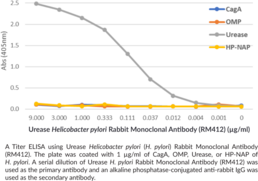
Helicobacter pylori (H. pylori) is a Gram-negative bacterium that can infect and colonize the stomach, leading to chronic gastritis, stomach inflammation and oxidative stress, peptic ulcer disease, and gastric cancer.1 H. pylori urease is a nickel-dependent enzyme that catalyzes the hydrolysis of urea to produce ammonia and bicarbonate, an effect that protects H. pylori by neutralizing stomach acid and contributes to the pathogenesis of H. pylori infection.2,3 It exists as a dodecamer of four αβ heterotrimers composed of UreB and UreA subunits, which contain the catalytic active sites and mediate subunit association, respectively.3,4 H. pylori urease is expressed predominantly in the cytoplasm but is also present on the cell surface.3 The activity of H. pylori urease has been used as a biomarker for H. pylori infection.5 Cayman's Urease Helicobacter pylori Rabbit Monoclonal Antibody (RM412) can be used for ELISA.
WARNING This product is not for human or veterinary use.
References & Product Citations
1. Role of bacteria in oncogenesis. Clin. Microbiol. Rev. 23(4), 837-857 (2010).
2. Metalloregulation of Helicobacter pylori physiology and pathogenesis. Front. Microbiol. 6, 911 (2015).
3. Supramolecular assembly and acid resistance of Helicobacter pylori urease. Nat. Struct. Biol. 8(6), 505-509 (2001).
4. Surface properties of Helicobacter pylori urease complex are essential for persistence. PLoS One 5(11), e15042 (2010).
5. Helicobacter pylori urease for diagnosis of Helicobacter pylori infection: A mini review. J. Adv. Res. 13, 51-57 (2018).
Contact Info
Cayman Chemical1180 East Ellsworth RoadAnn Arbor, Michigan 48108 USAToll Free: (800) 364-9897(USA and Canada only)Fax: (734) 971-3640


