
Technical Support & Resources
Visit our FAQ
Contact Us
Toll Free Phone (USA and Canada Only): (888) 526-5351
Direct Phone: (734) 975-3888
Product Categories
Research Area
Application
Helicobacter pylori NAP Rabbit Monoclonal Antibody (Clone RM414)
Item No. 32345
Technical Information
- H. pylori Neutrophil-activating Protein
Shipping & Storage Information
Recommended Products
Certificates of Analysis & Batch Specific Data
Provide batch numbers separated by commas to download or request available product inserts, QC sheets, certificates of analysis, data packs, and GC-MS data.

Visit Our Cancer Resource Center
Find Tools & Resources to Study the Hallmarks of Cancer
- Cancer cell signaling & regulation
- Cancer metabolism
- Tumor microenvironment
Product Description
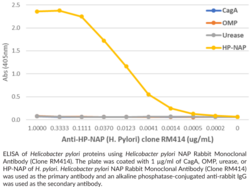
Helicobacter pylori (H. pylori) is a Gram-negative bacterium that can infect and colonize the stomach, leading to chronic gastritis, stomach inflammation and oxidative stress, peptic ulcer disease, and gastric cancer.1 H. pylori neutrophil-activating protein (HP-NAP) is a virulence factor and member of the DNA-protecting proteins from starved cells (Dps) family.2 It is composed of 12 identical monomers each containing four α-helices.3 It activates neutrophils and increases their infiltration into the gastric mucosa by increasing the production of reactive oxygen species (ROS), secretion of myeloperoxidase (MPO), and release of cytokines from a variety of host immune cells.2 HP-NAP protects H. pylori from bacterial DNA damage induced by this oxidative stress. It also induces a cytotoxic Th1 response in T cells in vitro and is a toll-like receptor 2 (TLR2) agonist that activates NF-κB in HEK293 cells.4 HP-NAP is an iron-binding protein, and H. pylori strains isolated from patients with iron-deficiency anemia have a SNP in napA, the gene encoding HP-NAP, and an increase in iron uptake compared with strains not containing the SNP.3,5 HP-NAP is immunogenic in humans, and oral recombinant HP-NAP administration is protective against H. pylori infection in mice.6 Cayman’s Helicobacter pylori NAP Rabbit Monoclonal Antibody (Clone RM414) can be used for ELISA.
WARNING This product is not for human or veterinary use.
References & Product Citations
1. Role of bacteria in oncogenesis. Clin. Microbiol. Rev. 23(4), 837-857 (2010).
2. Helicobacter pylori neutrophil-
3. The Helicobacter pylori neutrophil-
4. The neutrophil-
5. Positive relationship between a polymorphism in Helicobacter pylori neutrophil-
6. The neutrophil-
Contact Info
Cayman Chemical1180 East Ellsworth RoadAnn Arbor, Michigan 48108 USAToll Free: (800) 364-9897(USA and Canada only)Fax: (734) 971-3640


