
Technical Support & Resources
Visit our FAQ
Contact Us
Toll Free Phone (USA and Canada Only): (888) 526-5351
Direct Phone: (734) 975-3888
Product Categories
Technical Information
- Immunoglobulin A
Shipping & Storage Information
Recommended Products
Certificates of Analysis & Batch Specific Data
Provide batch numbers separated by commas to download or request available product inserts, QC sheets, certificates of analysis, data packs, and GC-MS data.
Product Description
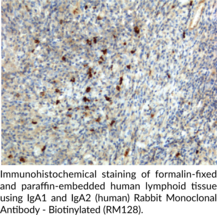
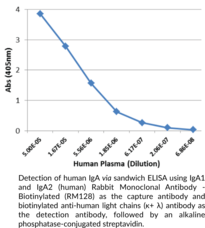
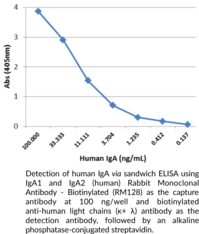
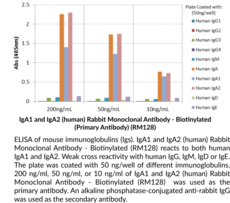
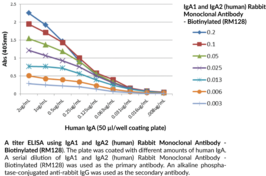
Immunoglobulin A (IgA) is a member of the immunoglobulin superfamily of glycoproteins with roles in host defense against intestinal pathogens and both quantitative and qualitative control of host commensal microbiota composition.1,2 Human IgA consists of two identical light chains of approximately 25 kDa each, as well as two heavy chains of approximately 60 kDa each that contain C-terminal extensions, known as tailpieces, which allow for IgA oligomerization.3,4 There are two IgA subclasses, IgA1 and IgA2, which are encoded by IGHA1/α1 and IGHA2/α2, respectively, and have differences primarily in the hinge and heavy chain constant regions.4 IgA is produced by B cells and later secreted by plasma cells and is the most abundant antibody on mucosal surfaces that comprises at least 70% of all Ig produced in mice.1,2 Monomeric IgA1 is predominant in the serum, but dimeric secretory IgA (SIgA) is the predominant form in mucosal surfaces and secretions with the ratio of subclasses varying based on the IgA-secreting cell types present.4,5 Dimeric and polymeric IgA bind to Igα Fc receptor I (FcαRI) and the IgM- and IgA-binding high affinity Igα and Igµ Fc receptor (Fcα/µ-R), which are both involved in mediating immune responses.5,6 Production of IgA is induced in the gut only in animals containing intestinal microbes, and the number of IgA-producing plasma cells is reduced in germ-free mice.1 Serum levels of IgA are decreased in patients with IgA deficiency, who are typically asymptomatic but may have allergy or autoimmune disorders or experience recurrent infections.7 IgA deposits in vessels and, in certain cases, the glomerulus in children with IgA vasculitis (IgAV), a disorder characterized by vascular inflammation, purpura, joint pain, gastrointestinal disturbances, and, in severe cases, glomerulonephritis.8 Cayman’s IgA1 and IgA2 (human) Rabbit Monoclonal Antibody - Biotinylated (RM128) can be used for ELISA, immunocytochemistry (ICC), and immunohistochemistry (IHC) applications.
WARNING This product is not for human or veterinary use.
References & Product Citations
1. The immune geography of IgA induction and function. Mucosal Immunol. 1(1), 11-22 (2008).
2. Role of secretory IgA in the mucosal sensing of commensal bacteria. Gut Microbes 5(6), 688-695 (2014).
3. The structure and function of human IgA. Biochem. J. 271(2), 285-296 (1990).
4. The structure of IgA. Mucosal Immune Defense: Immunoglobulin A 1-24 (2007).
5. Structure and function relationships in IgA. Mucosal Immunol. 4(6), 590-597 (2011).
6. IgA and the IgA Fc receptor. Trends Immunol. 22(4), 205-211 (2001).
7. Selective IgA deficiency. J. Clin. Immunol. 30(1), 10-16 (2010).
8. New insights in the pathogenesis of immunoglobulin A vasculitis (Henoch-
Contact Info
Cayman Chemical1180 East Ellsworth RoadAnn Arbor, Michigan 48108 USAToll Free: (800) 364-9897(USA and Canada only)Fax: (734) 971-3640


