
Technical Support & Resources
Visit our FAQ
Contact Us
Toll Free Phone (USA and Canada Only): (888) 526-5351
Direct Phone: (734) 975-3888
Product Categories
Application
Technical Information
- AMPK Subunit α-1
- MGC33776
- MGC57364
- PRKAA1
- AMPK Subunit β-1
- HAMPKb
- MGC17785
- PRKAB1
- AMPK Subunit γ-1
- AMPKG
- MGC8666
- PRKAG1
Shipping & Storage Information
Recommended Products
Certificates of Analysis & Batch Specific Data
Provide batch numbers separated by commas to download or request available product inserts, QC sheets, certificates of analysis, data packs, and GC-MS data.
Lipid Resource Center
Discover Products & Resources for Lipid Research
- High-purity lipid standards
- Lipid roles in biology
- Lipids in health & disease
- Lipids for pharmaceutical development
- Protocols, advice, & resources
Product Description
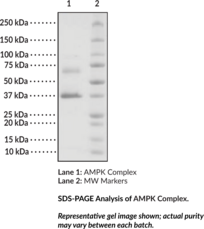
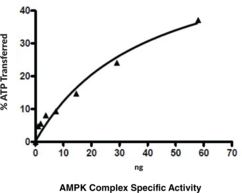
AMP-activated protein kinase (AMPK) is a heterotrimeric serine/threonine kinase.1 It is composed of an α subunit, two β subunits, and two γ subunits. The α and β subunits each have two isoforms, designated as α1, α2, β1, and β2, which differ at residues affected by post-translational modifications, and the γ subunit has γ1, γ2, and γ3 isoforms. The diversity of isoforms that can comprise the AMPK complex impart differing functions and subcellular localization.1,2 AMPK is ubiquitously expressed in eukaryotes, and AMPK complexes containing an α1 subunit are localized to the cytoplasm.2 AMPK is activated by phosphorylation of the α subunit by kinases and/or by AMP or ADP binding to the γ subunit, which occurs under low energy conditions with high ratios of AMP/ADP to ATP, or an increase in intracellular calcium levels.1,3 In this way, AMPK acts as a regulator of cellular energy homeostasis. It can also be activated under conditions of oxidative stress, where it functions as a redox sensor.2 Its activity is decreased under high energy conditions where ATP, glucose, fatty acids, and amino acids are plentiful.1 AMPK is involved via its downstream signaling pathways in lipid and glucose metabolism, protein synthesis, autophagy, and redox regulation, as well as inhibition of inflammatory processes.1,3 AMPK activation in vivo reduces adiposity in mice, as well as inhibits proliferation of cancer cells in vitro and reduces tumor growth in mouse xenograft models.2 Cayman's AMPK α1, β1, and γ1 Subunits (human, recombinant) protein can be used for enzyme activity assay applications. This protein consists of 1,160 amino acids and has a calculated molecular mass of approximately 146 kDa.
WARNING This product is not for human or veterinary use.
References & Product Citations
1. Regulation and function of AMPK in physiology and diseases. Exp. Mol. Med. 48(7), e245 (2016).
2. AMPK: A cellular metabolic and redox sensor. A minireview. Front. Biosci. (Landmark Ed.) 19, 447-474 (2014).
3. AMPK: A nutrient and energy sensor that maintains energy homeostasis. Nat. Rev. Mol. Cell Biol. 13(4), 251-262 (2012).
Contact Info
Cayman Chemical1180 East Ellsworth RoadAnn Arbor, Michigan 48108 USAToll Free: (800) 364-9897(USA and Canada only)Fax: (734) 971-3640


