
Technical Support & Resources
Visit our FAQ
Contact Us
Toll Free Phone (USA and Canada Only): (888) 526-5351
Direct Phone: (734) 975-3888
Product Categories
Product Type
Application
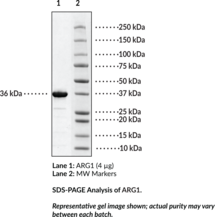
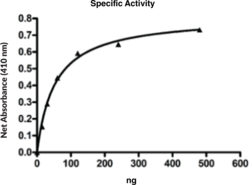
Technical Information
- Arginase-1
- Liver-type Arginase
- Type I Arginase
Shipping & Storage Information
Recommended Products
Certificates of Analysis & Batch Specific Data
Provide batch numbers separated by commas to download or request available product inserts, QC sheets, certificates of analysis, data packs, and GC-MS data.

Neutrophil Biology Wall Poster
Explore how neutrophils shape the immune response in health and disease. This poster highlights neutrophil pathogen defense mechanisms, including phagocytosis, degranulation, and NETosis, as well as neutrophil roles in inflammation and NET-associated pathologies.
DOWNLOAD NOWProduct Description
Arginase-1 (ARG1) is a manganese-metalloenzyme that catalyzes the irreversible hydrolysis of L-arginine into urea and L-ornithine with roles in polyamine synthesis and tissue repair.1,2,3 It functions as a homotrimer with each subunit containing a binuclear manganese cluster at its active site.2 ARG1 is expressed primarily in the liver, and at lower levels in various extrahepatic tissues, including the heart, lung, intestine, and stomach, as well as the CNS, blood vessels, and M2 macrophages.1 Loss-of-function mutations in ARG1 are associated with the autosomal recessive disorder arginase-1 deficiency that is characterized by neurological impairment, growth retardation, spastic paraparesis, and hyperargininemia.2 ARG1 expression is increased in lung homogenates isolated from patients with asthma.4 Cayman’s ARG1 (human, recombinant) protein can be used for enzyme assay applications.
WARNING This product is not for human or veterinary use.
References & Product Citations
1. The role of arginase in aging: A systematic review. Exp. Gerontol. 116, 54-73 (2019).
2. Arginase-
3. Arginase-
4. Functionally important role for arginase 1 in the airway hyperresponsiveness of asthma. Am. J. Physiol. Lung Cell Mol. Physiol. 296(6), L911-L920 (2009).
Contact Info
Cayman Chemical1180 East Ellsworth RoadAnn Arbor, Michigan 48108 USAToll Free: (800) 364-9897(USA and Canada only)Fax: (734) 971-3640


